19 February 2012

Collected Short Stories: Vol 4

Pages: 576


Much of what Maugham wrote was always greatly influenced by the numerous travels he made. In the course of his momentous writing career, there were few countries and cities that he did not visit. Yet, by his own admission Maugham found it difficult to open up and talk to the many strangers he encountered during his journeys. At the core he was a shy and introverted man. This, Maugham believed was an unfortunate handicap for a writer. Especially because no one could have been more interested and fascinated than him by the oddities in the men and women he met. Yet, he seemed to have managed rather well, as these experiences provided a rich source material for his stories.

And of course he had his fecund imagination. Maugham has been quoted saying that he could spend an hour with a person and quite comfortably come up with a decent enough story. But not everyone became a subject-matter for the writer, and what Maugham looked for in people was a singularity of character or circumstance.
Though a naturalist, Maugham laid a fair emphasis on making his stories engaging and entertaining and had a natural instinct for drama. Hence all the stories you see in this Volume (as is the case with all his writings), have something extraordinary in them, one way or the other.

As always, Maugham gives a lush description of his characters' physical self, surroundings, background. Often what the characters reveal in the end is an entirely unknown and unlikely facet of their personality. It is this hidden possibility in people that interested Maugham the most. Like a pathologist in a chemical lab, he liked to mix substances in various kind of solutions and watch the reactions that could take place.

These were stories that Maugham wrote during his stay in the Far East (Singapore, Malaysia). The place was under the rule of the British and the period setting is somewhere before WW2. The land at this point is dotted with Englishmen, as consuls, planters, skippers, captain and others. Their lives in the colony, interaction with the local Malay populace forms the subject matter for many of the stories. The steam ships that made travel so much easier in later years and completely altered the Englishman's attitude to his stay in colonies (he saw it as a temporary abode now as opposed to earlier), was yet to come. The long and dry ship journey also forms a significant backdrop to the tales.

This was a time when once an Englishman left for a colony, he spent almost his entire lifetime there. Often he took in a Malay wife as well, though the relation had no legally binding, and many left the woman and children behind (albeit well-provided for) if they did think of going back to England.

The White officers had important positions in the native land with spacious houses and a retinue of servants to do their bidding. This was convenient as well as flattering to the Englishman, many of whom took the posting out of some constraint back home. Suddenly now, they had power and enough money. Where they would have to follow the strictest austerity to make ends meet in England, here they could
almost be counted as rich. Naturally many looked upon with nervousness the prospect of going back to their homes after the end of their tenures. Many just stayed back,since by then they grew so comfortable in the skin of the native atmosphere. In fact, many of them didn't even relish the idea of confronting another White man after all these years.

Every story in Vol 4 is a gem. 'The Outstation' about two White men, a superior and his deputy, and the corroding effect of their mutual hate, is especially brilliant. These two men staying and administering an alien land, far away from their own country, despise each other, as both are offended by the other's peculiar bearing. Warburton, the colonial officer, is widely considered a snob, because he adores aristocracy and replicates the same English habits in the colony. Yet, he is fair and reasonable in his duties, and very fond of the natives. He isn't very thrilled on being told that a White man would be joining him in the district. The anxiety turns into a severe irritation when he meets the man who would be his deputy. Cooper, having heard of Warburton's elitist bearings, is determined not to appear subservient in any way. Believing offence to be the best form of defence, Cooper gets outspoken and rude. Warburton is positively shocked and offended by his junior's words but is keen to appear fair and dignified at all times. Their hatred grows with time with each being consumed with a gnawing anger for the other. Maugham achieves great narrative constancy, and the story is a marvel in character build up.


There's a pattern that starts to emerge with the stories. Just when things appear all hunky dory - and Maugham sadistically builds up an enviable image of felicity - a change in circumstance occurs that upsets the original status quo. It initially causes irritation and finally gives way to a deep seated resentment. From there on things quickly begin to spiral downwards. Repressed anger and despair finally end in a shocking catastrophe.

Appearance v/s reality is also another recurring theme in Maugham's stories. Things are never as they seem, and appearance and bearing often belie a dark, complex and unexpected side. ('Red', 'The Letter')

The other important theme is the impermanence and doomed nature of love and marriage. Infidelity is a running theme in most of the stories. (A Casual Affair, Neil Mac Adam, Episode, A Woman Of Fifty, The Letter, The Back Of The Beyond.)

Many of the stories point to the inherent confusion among humans, where situations are strangely always at odds, This makes men and women fickle, impulsive, and drives them to act in mysterious ways. This is true in Maugham's fiction, as much as it is the case in real life. One wonders if this is the greatest tragedy God inflicted on man where he would never get what he truly desired, and if at all he got it, he would stop desiring the very same thing.

As always, Maugham writes with tremendous skill and heart. The descriptions are slightly more lavish, given that the book is a travelogue of sorts. There are some elegant passages about setting and nature. But Maugham's greatest strength as a writer remains his ability to be lucid, and stick to his point without ever rambling. Every line he writes adds to the cumulative power and impact of these unforgettable stories.

17 February 2012

The Dutch Treasure Trove

Renee Ridgway recently unveiled an archival find, a 17th century book on medicinal plants created by the then Dutch governor in Cochin. The event, held at David Hall, Fort Kochi aimed at looking at the fascinating impressions the Dutch left behind


In the 17th century, when the Dutch came to Cochin for trade purposes, and eventually became its rulers, an interesting episode took place.


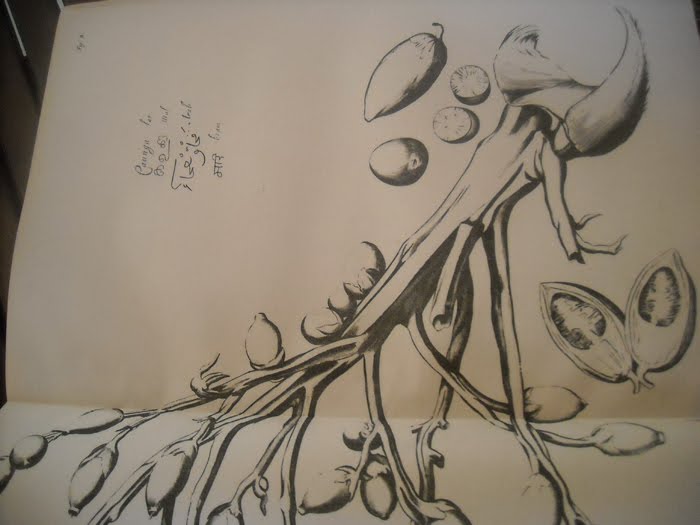
The then Dutch governor Hendrik van Reede undertook an unexpected and novel project. Probably impressed with the lush verdure around, he grew interested in medicinal plants and collaborated with the local Keralite doctors, botanists, translators and artists to bring out a book on the findings. People were sent far and wide across the state to gather plants. Local doctors would then assess their medicinal properties, after which drawings would be made in water colours. The King of Cochin also helped him in this endevour. It was between 1678-1693 that this 12-volume work, illustrating as many as 700 indigenous plants, was published in Amsterdam.

(Dutch governor to Cochin, Hendrik van Reede)


This is undoubtedly a fascinating piece of archival history. And it is not surprising that 350 years later it should have caught the attention of visual artist Renee Ridgway, a keen student of history. Though a proud American in every sense, Renee was always interested in Dutch colonial history “I grew up in a Dutch colony in the US. Also, it also has something to do with my mixed ancestry,” she says, as we sit for a chat at David Hall on a hot, sweltering day.

She went to Netherlands for her studies, which further helped her understand the Dutch culture and history some more. Some time later Renee was battling with her migraines and sinus problem. No treatment seemed to be working. This is when someone suggested an ayurvedic doctor, Kochi-based Thomas Punnen to her, who was then in Netherlands. She was cured, and this instilled in her tremendous faith about the line of treatment. This reference somehow got her acquainted with Hortus Malabaricus, ‘the book’ that was compiled in the 17th century.

Her passion for history, her faith in traditional Indian medicine, and love for nature (“I worked in a flower shop in Netherlands”)all came together, and Renee decided to get to the heart of the matter. “I had come to India before, but never to Kochi. I knew there was a Dutch settlement here, and it was while I was staying at the Kashi Art Residency at Fort Kochi in 2007, that I became determined to find more about it. David Hall, that has now become a hub for art and food events, was in ruins then," she says. Ironically, this Dutch heritage building is where the entire project was undertaken, says Renee. “There’s good evidence that the project was carried out at David Hall. Where else could it have been?” she says. And now this is the venue for the unveiling of Renee’s own project on Hortus Malabaricus that she along with her filmmaker-friend Rick van Amersfoort undertook.


(A copy of the book, Hortus Malabaricus)

The launch of the book, and an extensive discussion held between Feb 15-22 aims to focus on the cultural exchange that has occurred over the past 350 years on the Mallabar Coast between the Dutch and the local population.

The research also allowed Renee to delve deeper into the Dutch social ethos. "The average Dutch person is a very business-oriented person. Unlike the British or Portuguese, the Dutch did not have any emotional ties with the colonies they ruled. Neither did they aspire to propagate their religion. All they were interested in was trade. They came to Cochin for the spices," she says.


(an illustration from Hortus Malabaricus)

So what could have prompted the then Dutch governor to come up with the project?Renee is reluctant to answer, simply because she would like one to draw inferences from the vast footage of documentary she has gathered. She relents, "I think there were a couple of things. He could have been genuinely interested in the field of plants and medicine. He also found the local population very fit, and perhaps wanted to know how. But the real reason appears to be that he wanted the Dutch soldiers to be healthy, and traditional, local medicines would work out cheaper than procuring it all the way from Netherlands," she says.

The book was more recently translated in English, and is now more accessible to people. “The stunning thing is that the contents of the book have been in circulation one way or the other," she says.

07 January 2012

Somerset Maugham's Liza Of Lambeth


Liza Of Lambeth (1897) is perhaps Maugham's only novel which I don't have the heart to revisit. Not because it is poor, but because it is so chillingly tragic. It isn't as if his other novels are all light and sunshine. Maugham in fact always had a great eye for human tragedy and unfailingly took up themes about the impossibility of love and the doomed nature of marriages. Almost every single novel of his has a grim death in it, but nothing is as brutal as what one witnesses in Liza of Lambeth. The graphic violence and the extreme misfortune of the lead character evoke a deep sense of horror.

The book was written by Maugham when he was all of 23. It was his first attempt at writing a novel, and this he did while practising as a doctor. His work took him to the doorsteps of the poor and needy in the slums of Lambeth, and it is his experience and observations here that gave him the material for the book. To his own surprise, the novel was fairly well-received when it was published, and soon Maugham got more offers to write.

The novel is Maugham’s shortest, and also most unlike his other works. Liza of Lambeth appears distinct because it is so removed from the world the author generally sets his stories in ie upper class London. Here, in a ghetto, where the labour class resides, the mood and tenor are vastly altered. Also, a large part of the book comprises of conversations in the local slang, which makes it that much tougher to read. Yet, the story is engaging, and in the end, fans of the author will recogonise many things in the novel that only Maugham could have written.

Liza Kemp is one of the prettiest girls in Lambeth, a veritable lotus in the muck. Her life is not all rosy though, as she works as a labour girl in a local factory and then comes home to a sick, nagging mother who never has a kind word to say to her. Tom is a young, honest man, madly in love with Liza. She, however, only looks upon him as a friend and is repulsed with the idea of romancing him. Her good friend Sally is excited about going on a boat fair with her boyfriend and urges Liza to accompany them. Tom is willing to pay for her, but Liza doesn’t think it appropriate that she should take favours from someone she has no intention of marrying. Tom reassures her that he’s fine even if Liza is not interested for the moment. That instantly cheers Liza, who joins everyone else hoping to have a great time. Another reason for her happiness is the presence of Jim Blackeston, a handsome man who has recently come to stay in her neighbourhood. Jim is married with an imposing looking woman and three children. Liza feels an instant attraction towards him, and the feeling is reciprocated. Ignoring Tom, Liza tries her best to be around Jim. This angers Tom, while Jim’s wife, probably too preoccupied in other domestic thoughts doesn’t notice much. The attraction grows into a full-fledged affair and slowly tongues start wagging. Jim talks about deserting his wife, whom he says he cannot stand.

The situation starts to get messy as the women-folk refuse to take kindly to the affair. They naturally sympathise with the wife and see Liza as a callous husband stealer. When Jim’s wife senses that her husband might be leaving her for good, she unleashes her anger on Liza, giving her a fatal beating in full public view. The scene is grotesque, but it is just the kind of violence one would expect in such a place.

Jim Blackeston is pained by Liza’s death, and in anger beats up his wife. But there is every indication that he would go back to his same shoddy life and forget about the chapter with time. Liza’s mother is more concerned that she would have no one to look after her henceforth. Liza is a picture of such youthful exuberance and optimism in the novel that the reader feels an intense sadness at her life being snuffed out with such brutality. One of earliest scenes in the book has Liza exultantly walking down the street, like a diva. She stirs up a sensation and the men nearly faint with excitement. To then see her beaten black and blue on the same crowded street with no one coming forward to help in the climax leaves you with a feeling of cold disgust.

For its striking differences with Maugham’s others work, the novel still has all of his favourite themes – the mundane pattern into which marriages invariably slip into, and the all-consuming power of passion that makes individuals blind to its risks and short-comings. And Maugham since the very start seemed to understand that for many, ‘the important thing was to love rather than be loved’ Like in his other novels, here too Liza can very well go for a respectable match by way of Tom. But she simply is not drawn and cannot help it. This is a recurrent theme in almost all of the author’s books – the inability to love what is gettable, and an idealisation of a potentially destructive relationship.

Again, the disillusionment of marriage, a recurrent theme in Maugham’s oeuvre, finds a distinct voice in Liza of Lambeth too.
Jim Blackeston’s marriage has slipped into dull, domestic monotony, which is why it doesn’t take him long to fall for a younger woman.
Contrasting Liza's uncertain, desperate state is her friend Sally, who is smug and happy with her relationship and is all set for conjugal bliss. But as usual, Maugham builds a perfect apple cart only to upset it. Post marriage, Liza discovers that Sally’s husband beats her up regularly, and that all traces of love had evaporated. Sally though is too proud to admit this.

Even though the book is too grim for me, I don’t see it lacking in merits. The story is engaging, the conversations are credible, and the situations unfold with perfect plausibility. Importantly, it reveals that Maugham’s ideas about love and marriage – the two central themes of his novels – remained more or less unchanged till the very end.

13 December 2011

Elizabeth Gilbert's Committed


Haven't we all at some point typed  an intimate question on Google search for user responses.  This mini research offers you perspective and the assurance that you are not alone in it.  It also gives you some validation for your point of view.
Elizabeth Gilbert, in writing, 'Committed' was clearly going through a similar anxiety. Her last book, 'Eat Pray And Love' had yet to become a best-seller, and the 38-year-old was in a hopeless, new predicament. To marry or not to marry.
It is through this confusion that her memoir was born.  Not convinced about marriage, and yet seeing no way out of it, Gilbert goes on a journey of exploration into the institution of marriage.  In her travels to places, she chats up people from communities who lead lives and hold opinions very unlike her own. She scans through books on marriage, goes through handy research on the topic, all the while drawing parallels with her own life;  an impulsive first marriage, a string of failed relationships and now a dilemma about marrying again. What you get in the end is a book that is both absorbing and insightful.
Gilbert's scepticism about marriage is genuine and you can literally feel her grappling for answers and reassurance through the 280 odd pages of this long book.
She is happy to be with her current boyfriend, Filipe, a Brazilian-born man of Australian citizenship and even more happier about their arrangement. Neither wants marriage, as both are happy leading their separate lives in different continents, and meeting each other every month. Both have been scarred by earlier divorces. Gilbert is particularly worried about being financially vulnerable if she opts for marriage. As a single woman who makes her own money, she is extra cautious this time. Most importantly, Gilbert is unsure about herself, given her predilection for disastrous romantic entanglements.
She loves the companionship and affection in her current relationship. Both see their bond as a permanent thing and yet Gilbert is not enamoured enough by it to consider marriage. She has no desire for kids, and as a woman living in a Western world, singlehood is no big deal. So why marry at all, she asks.

The plan get upturned when Felipe's constant travel to US evokes suspicion and he faces threat of being deported. They must either marry and stay in US or then be singles, but face other relationship challenges. They decide to get married but Gilbert is filled with doubts.
While reading this book, I kept getting the feeling that Gilbert is just not that into her boyfriend. I may be wrong here, but many times in the course of the book I felt Gilbert was trying to justify her soon-to-happen marriage, in the hope of seeing  her relationship as viable. She gives many reasons for her anxiousness, and even admits that she is not madly in love with Felipe and thank god for that, she says. She is balanced and alert this time, which is perhaps why she fine combs every aspect of the relationship. But at the end of it, I wasn't sure if that sort of moderate approach also works with everyone.  Gilbert is right that infatuation does not last. Certainly the hormonal rush and exhilaration brought are bound to subside, and one ought to be realistic about it. Familiarity, at its worst, breeds contempt, and at its best cultivates affection.  But when one enters a union like marriage, conviction is a must.
Falling in love does not always imply recklessness. Yes, one tends to overlook a few things perhaps, but one still looks out for many enduring qualities (Pride and Prejudice?). This then translates into attraction and when couples instinctively feel it's the right relationship for them, they take the plunge quite happily.  The important thing is belief that it will work. Of course nothing can be said about the future, but to my mind there is nothing riskier than treating marriage like a 'sentence' which is the word Gilbert uses for her relationship. She is filled with doubts and most will agree that it happens when you are simply not sure if he's your man. It's not the marriage at all.
Anyway, so thus she begins her research project on marriage, its history, its cultural meaning and significance that differ from community to community. She also looks at marriage of the past and present, comparing her perspective with that of her mother. She looks at the roots of marriage, and is surprised that an institution which is considered sacrosanct today, was something which custodians of religion were opposed to. They wanted people to reject it and adopt celibacy. That never happened of course, and no matter what stand the State or religious body took, men and women always have felt a natural inclination to come together and marry. Which establishes that men and women have always held the desire to get married.
 Gilbert's narration is seamless as she talks about her own relationships and attempts to seek answers on larger questions about marriage. One chapter that is especially illuminating is Marriage And Infatuation. There is the oft repeated view that while marriages in the past endured many a storm,  they now fall apart for the flimsiest of reasons.
Gilbert using research findings and expert opinions brings forth some perceptive ideas. In most cultures, she says, women rarely questioned marriage. They accepted their fate and role. But with industrialization and the breaking up of the joint family system, the 'individual' suddenly came into focus and his/her private desires took precedence. Now, couples didn't necessarily marry because the spouse was 'beneficial' to the family as a whole or a convenient arrangement to all, but because they fell in love. Gilbert rightly points out that when a marriage is based on love and not on a collective arrangement, it has more chances to fail - precisely because love, she says, is a very fragile emotion. What if you fall out of love? Which is why modern couples are divorcing more than ever before, and she says the institution itself is under tremendous pressure.
Yet, Gilbert says she wouldn't trade her life as a modern, educated, self-aware American woman of today with any woman in a previous time and culture who had a conditioned idea of marriage. Nor does she believe that people must not marry for love. But she points out that one must be equipped with sufficient tools to deal with practical and emotional problems before they get into it.
That is precisely what Gilbert decides to do this time with her beau. She says she is thankfully not infatuated this time. She loves the narcotic high of love, but is happy not to go through it again. She is on as more emotionally secure and saner ground this time, and both, she and Felipe discuss in some detail about dodging the potential landmines in their future marital relationship.
I really liked a chapter where Gilbert talks about the possibility of one's perfectly nice spouse falling for someone else.  "History teaches us that just about anybody is capable of just about anything when it comes to the realm of love and desire. Circumstances arises in all our lives that challenge our most stubborn loyalties. Maybe this is what we fear most when we enter into marriage. - that "circumstances," in the form of some uncontrollable outside passion, will someday break the bond."
One might think that this is an unavoidable situation, but Gilbert finds that it is not so! Regretting that she did not have this wisdom when she got married at 25, she notes how couples can drastically reduce such a risk of infatuation by containing the situation early on.  One makes friends with a member of the opposite sex, and it is all harmless for a while. But somewhere an intimacy creeps in and one reveals more than one ought to and this is by default becomes a breach of marital trust. Soon, this gets emotionally complicated.  Gilbert feels that with some clear-sightedness and responsible behaviour, this risk can be drastically minimised.
She takes you through the bumps and jerks in her own relationship with Felipe, describing moments that infuriate and frustrate her. Yet, she offers a reason for sticking it out in a relationship. "He was a good man, in the end."
There might be a few readers (read men) who will chuck this book in irritation, unable to understand Gilbert's complex, over-analysing mind.
But most women will like the book and will appreciate the candour and honesty . The writing is fluid and extremely readable. Gilbert is witty, entertaining and wields a formidable pen.  And yes it is time well-spent.

04 October 2011

R K Narayan's The Dark Room and The World Of Nagaraj


Very few readers will dispute the talent that R K Narayan was. He was the first Indian writer in English to acquire such a name for himself both among native as well as foreigner readers.
V. S Naipaul has written how his image of India was entirely shaped by reading R K Narayan's books and all that happens in Malgudi, the fictional small-town in South India that the author set his stories in. His tales came with a parochial delight, yet encompassed a world of human emotions and characters. This was enchanting as much as it was universal in appeal.
Still, every now and then one hears of a not-so-flattering comment about Narayan's prose. At times it cannot be completely dismissed as it comes from say a Shashi Tharoor who in his wonderful book on his literary passions, Bookless In Baghdad writes candidly about Narayan's weaknesses calling his style 'flat and monotonous'
Tharoor writes, "Some of my friends felt I was wrong to focus on language – a writerly concern - and lose sight of the stories, which in many ways had an appeal that transcended language. But my point was that such pedestrian writing diminished Narayan's stories, undermined the characters, trivialised their concerns."

Narayan's writing had its flaws, and within his own ouevre some were more successfully executed than the others .  The Dark Room (1938) and The World Of Nagaraj (1990) are an example of that. Both have plots that draw you in, but each vastly differ in the manner in which they are written. The Dark Room has a poignant theme, but Narayan struggles with the writing and is unable to etch out the deeper nunances inherent in the story. Tharoor's criticism is quite right here.
 Nagaraj...on the other hand is the work of an accomplished genius. It's not the plot, but the character that drives the story and here Narayan shows tremendous writerly gifts.

The Dark Room is about a dominant, excessively critical and self-centered husband, Ramani living with his wife Savitri and three children. The first scene sees him criticising everything that his wife serves him on the table. He curses the cook and freely taunts his wife. At work, he takes more than a little fancy to a junior called Shanta Bai. She is pretty and recently separated from her husband. Ramani is taken in by her charms and goes out of his way to help her out, including vacating a spare room in the office and even making his wife give away some of their furniture to make Shanta comfortable. On the way from his golf club, he regularly starts spending time at her room, and sits entranced listening to her.

When Savitri hears of it she is unable to bear the humiliation . She confronts her husband who dismisses her objections. Desolate at being taken so entirely for granted she raises her voice and then is determined to leave the house. She wants to take the kids along, but Ramani stops her harshly. “Don't touch them or talk to them. Go yourself, if you want. They are my children," he shouts.

The blatant disregard shown by her callous husband causes such depression in her heart that she wanders alone in the street and even plunges herself in the river. But overcome by fear, she shouts out for help. A blacksmith by day and burglar by night saves her. He brings along his wife, Ponni who tries to befriend Savitri. She offers her shelter and food. But such a madness seizes Savitri that she refuses to eat anything not earned by herself. She is disgusted at being at the mercy of the men in her life – father, brother, husband. She gets so obstinate about not taking any more charity from anyone that she starts working at a temple as a cleaner for a cantankerous priest. But in a day she realises the impracticality of her choice and returns home, though a part of her is dead now. Ramani is relieved to find her back, less for her sake, and more to keep up social pretenses.

 Narayan's sympathies are with Savitri though he resists from make a grand feminist statement. She leaves the house for valid reasons, but reconciles and comes back. Narayan, above all, much in the vein of say a Jane Austen was a realist and understood the limitations of people in their context and worlds. Narayan's characters rebel against a traditional and regressive society. Earlier in Bachelor Of Arts, the young protagonist is sickened at his inability to get the girl he wants and turns a monk for a while. But quickly realising the narrowness of his world, comes back into the mainstream.

In The Dark Room, Narayan quite clearly feels a deep anguish at the wife being treated shabbily and leaves no opportunity to portray the ugliness and selfishness of the husband's character.

The book is less of a novel and more of a novella. Narayan is effective in his portrayal of Ramani, a vain, sarcastic, self-serving man. Also, the part where Savitri leaves and encounters a different world is poignant, but the book as a whole has a few weaknesses. It is not as lush in its narrative, the story runs rather quickly, and doesn't delve too much into the complexities. Ramani's fling with his junior is awkwardly handled, perhaps because Narayan was writing about an episode he may not have experienced or seen first hand. The 'other' woman's character also remains shadowy.


None of those problems are there in The World Of Nagaraj, which is an unqualified classic. It could be because it was written in Narayan's later years, and the narrative has a fluency and depth that is quite amazing.
Since I read both books back-to-back, I felt an instant difference reading ...Nagaraj. One's reading pace is automatically slowed, as you try to absorb the atmospherics and the dense description of the leading character. The book is about a simple-minded, pleasant man, living with his wife, Sita and mother in a rather grand ancestral house called Kabir Street. He loves day-dreaming and talks a great deal to himself. His life's ambition is to be a thesis on sage Narada. Humble and affable, Nagaraj has no worries until his nephew Krishnaji, referred to as 'Tim' comes to stay with him. Narayan - through a series of flashbacks gives a vivid picture of the family characters. Gopi, the elder brother is aggressive and dominating. Until their father is alive and they all stayed together, Gopi took the best room, where he and his wife would stay locked in. The wife would cook savouries in limited portions and take them directly to their room. When the will is read out, Gopi asks for the farm house and lands in the village. This suits Nagaraj who prefers having the house in Malgudi.

Sharp-tongued and abrasive, Gopi looks at his younger brother as a bit of a fool, and openly insults him for his dull replies. Nagaraj being supremely unassertive, takes many of his brother's put-downs as a joke, trying to maintain a semblance of cheerful normalcy.

The entire book brings out the predicament of a man who cannot stand up for himself and confront situations. There is a scene in the novel where Tim and his wife have come to permanently stay in Nagaraj's house. This is the time when the latter has finally decided to get serious about his theses on Narada but Tim's wife is in the habit of playing the harmonium in the mornings and this is a source of intense irritation to Nagaraj. His impulse once prompts him to bang against her door and ask her to shut up. But he weakly smiles and walks away when she actually opens the door.

Narayan's point seems to be that it is human nature to take for a ride, and be insensitive to the needs of those who don't stand up for themselves. A complete lack of ego or pride is viewed as a grave weakness by others and the obvious response is to take the person for granted. Nagaraj's nervous reactions are both amusing and frustrating to watch. You want him to give up his meekness and take on his supercilious brother for once. The ending is poignant, and perhaps even sadder than The Dark Room.

But both novels leave you with a feeling of exultation as they give a wonderful psychological insight into human character and throb with a natural goodness so unique to R K Narayan's works.

17 July 2011

Priya - Namita Gokhale

Author: Namita Gokhale
Pages: 195
Price: 350
Publishers: Penguin


This is the first book I took up to review by Namita Gokhale, better recogonised as the co-director of the highly popular Jaipur lit fest. She's written 10 books already - which I had no idea about.

You see the book’s inane title and cover design and wonder if the rest of the book is going to be as unimaginative. Its tag line below further reads -'In Incredible Indyaa' - an obvious smart-alecky attempt taking a dig at the socialite obsession with numerology. The author tries hard to satarise a certain class of people with their pretentions and superficial airs -the irony though is that the novel itself feels impossibly artificial and snooty.

The characters are not fleshed out and come across as obnoxious caricatures. Also, the author's own personality seems to pervade heavily on the way these people speak. The result is not pleasant. The men don't sound like men. For example, the 45 something protagonist’s teenager son speaks dialogues such as these, “ Honest! That’s what her feminist-sheminist mother said. And her father got really upset, he even tried phoning Pitaji. He didn’t get through - all the PAs and secretaries saw to that. And then I sort of surrendered, and agreed to marry Monalisa. Her parents got uber excited. I think they had dreams of Band Baja Ghodi and Disco Bhangra and all that! Or Some Bengali fancy-dress tamasha”
Phew!

Gokhale's latest is a sequel of sorts to the her earlier novel titled Paro, about a free-spirited, promiscuous woman. Priya has a presence in that book too. She is the more timid, staid one. She grows up as a middle-class girl in Mumbai, marries Suresh Kaushal, who in an unexpected windfall turns into a successful minister at the centre. This change in fortune is quite sudden and Priya’s lifestyle transforms overnight. She suddenly finds herself in the midst of political and Page 3 glitterati and has new 'challenges' to face every day.
She has twin sons, Luv and Kush. Luv is more artistically inclined while Kush is the more pragmatic one with aspirations of following his father’s political footsteps.

But these characters are etched with no subtlety at all. What should have been conveyed in the narration with crafty irony is done blatantly with tasteless dialogues. For example, the author wants to assert Kush’s clinical approach to things. So when he gets a marriage proposal he meets the girl and discusses her on the breakfast table next day with his parents. He announces,“I’ve assessed the Sethia chick...It’s like a merger or an amalgamation. One has to study the fundamentals."
This is plain nasty writing and one would be hard-pressed to find anyone talking like that. The approach may be a reflection of Delhi’s opportunistic and mercenary culture, but the dialogues do the narration in completely.

You have the husband Suresh having extra-marital affairs. Priya herself has an old flame whom she goes gallivanting with. There’s a Page 3 social climber type thrown in who talks about Botox and refers to Priya as Mrs Menopause. There is a ridiculous story about Luv and his love entanglements. Then just like that Kush turns out to be gay as well, and Priya is most sanguine about it. All this is laughably amateurish.

The novel's narration is in Priya's voice, but her character never really emerges in any sense. You never enter her head. Also, there are too many purple patches with needless adjectives thrown in. The author has the annoying habit of inserting all kind of Hindi words like ajeeb and adla badla as well. There's only one time when I thought a Hindi expression is well-used. 'Yaari-type hug' - I thought that captures a scene in an instant.

However, the entire book has a vein of artificiality running through it with shrill coincidences and poor plot-construct and characterisation.

The book has a few lines that are well written here and there - somewhere Suresh talks about India being a serpent with its hood being in the 21st century and tail still being in the dark ages. Also, some of the author's comments on Delhi's opportunistic culture and its obsession for private shorthand is interesting. The book is ambitious to the extent that Gokhale tries to etch out a novel driven entirely by atmospherics. Unfortunately, she's not upto the task.

06 July 2011

The theme of retribution in Delhi Belly


The fact that this Akshat Varma penned script, stylishly directed by Abhinay Deo is a tightly-woven, smartly executed one is something all reviews have agreed. Varma – probably on account of having studied script-writing abroad – follows one of the essential rules of filmmaking – not to waste details. Every scene and reference in small or big ways adds to the development of the film – sooner or later. The story by itself is not novel, but it is this adherence to a simple scripting rule that makes this mad-cap, irreverent flick seem instantly fresh and unusual from the run-of-the-mill Hindi-film experience.

But I come to a different point about Delhi Belly. This is not a film that is particularly bothered about appearing intellectual and profound – it is happy to be a dark, wicked comic thriller. And yet, I felt the film is very strong on subliminals. It’s not like the writer is necessarily aiming for it, but I detected a strong theme of retribution in Varma’s work.


Retribution is the idea of justice. You are punished for what you do wrong and rewarded what you do right. The three guys in the film (Imran, Vir, Kunal) stay in a dump, leading the most wretched, lazy, indifferent life. This is not uncommon with bachelors, but the writer recogonises that his protagonists need to wake up and gives them the jolt of their life. The film picks them up and throws them in the deep end of the sea, and challenges them to find a way out now. The fact that Varma has some affection for his protagonists goes without saying. These are well-meaning, decent chaps. But he raises a storm – makes everything go wrong for them – until they take stock of their life – a coming-of-age of sorts. They are rewarded in the end. Imran gets the girl he wants, and the three of them get to keep the pickings.

This is the overarching retribution theme, but it works in every aspect of the film’s development. The writer takes no high moral ground anywhere, but there a subtle sense of poetic justice embedded into his script. Portly Nitin freely ogles at an actress, takes her photos from ‘those’ angles. His next stop is to a brothel where he could be a regular. The boob-press scene shows he enjoys some familiarity around. Today he is on business. His intent? To take pictures of his landlord (for all outward appearances a working-class, respectable man) in compromising positions with a prostitute. Nitin finds a simple blackmail the best immediate option for their rent woes. The writer sets up these things in such a way that you can’t help feel that Nitin is probably getting his just desserts. He suffers a horrible stomach upset that embarrasses him throughout the film. Nitin’s ordeal might be funny to the audience, but it’s never once a laughing matter to anyone in the film itself. His smug expression at the start of the film is soon replaced by a helpless, jolted one.

The writer derives fun out of Nitin’s uncomfortable state, and also from the landlord’s, who gets a caustic tongue-lashing from his police inspector bro. Both get away in the end, because of a certain good act by them. Nitin stands by Tashi in his hour of need, and is clever – so he deserves the money he gets. Comically, the landlord – having no clue that Nitin is behind the blackmailing – like a helpful neighbour takes him to the clinic for his check-up. Naturally, this goodness melts Nitin’s heart, and once his own troubles are over, he wastes no time in sending the landlord an anonymous letter asking him to forget about the photos. “Lead a happy life’ it says. This is one of the most heart-warming scenes in the film, because this is the first kindly emotion the writer allows you to feel in this otherwise chaotic, crazed, messed up world.

The retribution theme takes full force with the character of Vir Das (Arup) who is ditched by his girl friend. Cinematically, he is allowed a grand revenge with Jaa Chudail, even though the story cannot follow the girl in question.
Sonia (Shenaz Treasurywala ) pays for her dumbness with humiliation at the hands of the gangster (Raaz). But to Akshat’s credit – and this would have seemed very sexist and unacceptable otherwise – he is not entirely callous with her character. Rightly, she slaps Tashi hard, in full view of others for ditching her. In the last scene Nitin wonders whether he can start dating her if Taashi is not seeing her anymore. “She’s hot!’ he says. So Sonia’s feminine graces are allowed to be kept.

The jeweller loses his money because he was a cheat. The most splendid character of the film Vijay Raaz – who the writer etches with great delight – has to die for not letting off his protagonist after he recovers his diamonds. But he’s not casually disposed off like a cheap villain. There is a cinematic grandness to his death as the shot hits his forehead and the blood drops in slow motion. Here was no ordinary man, the writer seems to say.

21 June 2011

Chinese Whiskers

Friends, this is a piece I did for Biblio, a one of its kind literary magazine in India - published from Delhi. I consider it a fairly important and essential platform for the intellectual exchange of ideas and information. I have attached its link. Readers can log in to the site and read


Author: Pallavi Aiyar
Publishers: Haerper Collins
Pages: 221
Price: 399


In one of her many interviews, author Pallavi Aiyar expresses her exasperation over too much “arm-chair analysis” that happens around the Indo- China relationship. To get a credible perspective on our Asian counterpart, she believes one must see things “ground up” rather than “top down” by observing the quotidian lives of its people. And Aiyar finds herself in a good position to do that, having stayed in Beijing for six years, first as an English teacher and then as a correspondent for The Hindu and The Indian Express. Like many expats in recent times, she has made use of this valuable experience to write two books on China, a society shrouded in ancient mysteries. This harmless cultural impulse apart, what has been worrying though is the Communist regime’s rigid monitoring and gagging of information, coinciding with the country’s dizzying success on the world economic stage. China elicits more interest now than ever before, and the fact that precious little fiction comes out of the country for the mainstream English reader, makes Chinese Whiskers all the more timely and interesting.

http://www.biblio-india.org/showart.asp?inv=21&mp=MJ11

16 June 2011

A longish essay on Uncle Tom's Cabin


Harriet Beecher Stowe's classic 1852 novel is best remembered for its emotional, conscientious appeal for the abolishment of slavery. The author, though White herself, had seen the lives of slaves from close quarters and could give a fairly accurate version of the atrocities that were heaped on them. The book's powerful, hard-hitting narrative had the desired effect and within 5 months of its publication nearly half a million copies were sold. The book became extremely controversial. By this time slavery no longer existed in North America. But it thrived in the South where slaves were an economic necessity, as they were needed in the fields. The Southerners put up a fierce resistance against attempts to change existing laws, leading to the Civil war in 1860s. The North won, and America was finally declared free of slavery.

Beecher's novel came a decade before the civil war took place and continued to have immeasurable influence on the political and social narrative on slavery. The Southerners expectedly slammed Uncle Tom's Cabin terming it exaggerated and even untruthful. However, the horrors that were captured in the novel and the psychology of human violence it brought out so incisively made a deep impression upon its readers. Over the years Beecher's novel grew so famous that it's characters - Uncle Tom, Eva, Simon Legree, Topsy became American by words. The novel was adapted for the stage many times and several film adaptations of it were made in the silent era. This did some disservice to the book "as many of these were garish dramatisations, emphasing the most melodramatic, seemingly improbable incidents in the novel", says Alfred Kazin in his introduction to the classic. For the later generation the novel turned into a caricature. "The characters had become such worn-out symbols that without knowing the book, people who mockingly used these symbols thought the book beneath their notice," he writes.

Yet, it's impossible to deny the novel's historical significance. It remains the single-most enduring novel written on slavery. Over the years the Blacks have come to view the book with with mixed feeling. The novel unquestionably aided in the abolition of slavery but many also saw the portrayal of Blacks as objectionable for a variety of reasons. Author and critic Charles Johnson's introduction for one of the newer editions is especially useful in understanding the Black point of view to the novel. Johnson -though he finds the novel untidy, full of contrivances, improbable situations and mawkish sentimentality, applauds it for its stupendous characters and narrative power. He states that much need not be made about these faults because this was the structure prevalent in the nineteenth century. Also, Uncle Tom's Cabin came at a time when fiction was being published in serialized form in newspapers, which meant there was the natural tendency to stretch a story too long. Beecher's novel came in 45 weekly instalments which explains its immoderate length. "What Uncle Tom's Cabin lacks in concinnity it more than makes up for by being fully imagined and deeply felt," says Johnson.

He sees the novel as a staggering success in terms of story-telling but firmly objects to the way Blacks have been portrayed, calling it 'ineluctably racist' "Stowe's interpretation of the 'nature' of Negros is her novel's most central and self-destructive flaw. It simple replaces one racist stereotype with another that is equally condescending and unacceptable." He goes on to say that this is typically the problem with most white Americans who will understand the racial and cultural "other" only 'in their own terms'

Johnson is especially displeased that the author tags Blacks with adjectives like 'patient, timid and unenterprising' Also, he believes Beecher overdoes her sympathy by showing all Blacks as innocent and good. Even Topsy who is a wild, irreligious child is someone who monkeys around and amuses people. So essentially, the argument becomes that Blacks ought to be freed because they are harmless and pet-like. It totally deflects from the simple ethical question of human freedom and dignity. These points are extremely valid. He even quotes Charles Dickens who was disturbed by Beecher's attempt at portraying Blacks in an over-the-top positive light. "I think this extreme championship is likely to repel some useful sympathy and support."

Similarly, while the Southern's felt that Beecher had fabricated the truth, Johnson on the other hand believes that her book only "touches upon the iceberg of two hundred years of depravity and cruelly inflicted on Africans"

Beyond these points of debate, let's also look at what the books actually aims to do. Without much doubt Beecher's social and moral concerns overpowered her artistic ambitions. The issue of slavery was foremost on the author's mind. And yet, she has a terrific sense of drama, and some of her characterisation is as good as it gets in classic literature. Yet, there are also painfully exaggerated figures she creates in the lead characters of Uncle Tom and Eva - the angelical do-gooders as symbols of Christ. Both epitomise Christian ideals of forbearance and sacrifice, and belong to the Black and White sides respectively. This choice of characterisation was most probably derived from the fact that Beecher was herself brought up on tales of Christian charity and brotherhood. Her faith was strong and her attempt was clearly to evoke the image of Christ amidst the cruelties she saw around her.
Where Beecher is really in top form is in her slow peeling of the evil characters. She demonstrates an immense and awe-inspiring talent in the description of Marie Clare and Simon Legree.

Now for the gist of the novel. The action starts at the Shelbys, a kindly family who treat their slaves well. However, when Mr Shelby's fortunes take a beating he is forced to sell off his loyal slave of many years, the middle-aged and diligent, Uncle Tom. He also plans to give away one of their female slave Eliza's son. When Eliza hears that her child would be taken away from her, a strange motherly power possesses her and she makes a great escape. Tom - the ever tolerant man meekly follows his new master, Mr Haley, leaving his wife and children behind. Tom is industrious and god-loving and doesn't face too many problems. But his stay with Haley is short-lived, as a young man of fortune and family, St Clare absorbs him into his large, picturesque household in New Orleans. St Clare buys Tom at a princely sum, since his little daughter Eva takes a great liking to him. Eva is portrayed as a little angel who cannot see anyone suffering around her and is always compassionate to everyone. She holds no prejudice of colour or class.

Her mother Marie is the polar opposite. She is hypochondriac and a nag. The author says describing her, "Marie had never possessed much capability of affection, or much sensibility, and the little that she had, was merged into a most intense and unconscious selfishness; a selfishness more hopeless, from it quiet obtuseness, its utter ignorance of any claims but her own. From her infancy she had been surrounded by servants, who lived only to study her caprices; the idea that they had feeling or rights had never dawned upon her even in distant perspective."

Marie intensely resents the fact that her husband is excessively lenient with their servants. She finds it absurd that he never whips them. Things seem to go along nicely for Tom for a while. But then almost suddenly Eva takes ill and dies. St Clare is a broken man but as kind as ever. He is keen to give Tom his freedom, but just days before the formalities can get completed, he too dies. Now at the mercy of their heartless mistress the servants start to get nervous about their altered circumstances. On one occasion Marie even sends one of her slave girls to a flogging house. Clare's middle-aged cousin, Miss Ophelia pleads the girl's case with Marie, but she obtusely holds on to her own position.

Marie sells off some of the slave, including Tom. This proves to be the third and final destination for Tom. His master Simon Legree is a ruthless, sadistic tyrant. Yet, he means to be decent with Tom as he sees potential in him and wants to promote him as an overseer. Legree, however, is uncomfortable seeing the pious side of Tom. His inhuman and immoral acts fill his heart with a dread of the unknown, and he gets determined to break his will. He asks Tom to flog a woman. When he refuses, he unleashes the worst torture on him. Finally, Tom dies at the hands of Legree's men, much like Christ.

The story is deeply moving and its emotional sweep is tremendous. Harriet Beecher Stowe's prose is compassionate and courageous, and it's not difficult to see that such a novel -with its particular nuances and shades - could only be written by a woman. Happy domestic scenes clearly delight the author and to her mind nothing can be more tyrannical than forcibly breaking up a family. This is the refrain throughout the novel. Slaves were allowed to marry but these marriages were not legally recognised and their owners very often would sell one half of the couple to anyone they wished. This inhuman aspect of slavery moved Beecher the most and she recounts countless episodes that show husband-wife and mother-child being cruelly separated. The author was evidently appealing to the sympathetic heart of White American wives and mothers, who would be able to feel the full impact of such an act.

The novel's other important theme is the psychology of violence. When irresponsible and uncontrolled power is placed with someone, human beings are capable of unleashing the most perverse violence on each other. This is what is revealed in the case of both Legree and Marie.
While the author portrays the 'good' in its purest form, reaching almost unrealistic levels, she is more interesting when she tackles evil in people. Ever the evangelist, she likes to believe that people can have a change of heart. Many characters in the book do go through that feeling.
The novel’s other strength is that it wonderfully penetrates into the psyche of women and captures how their minds operate. There is always a fair bit of guile and tact that women employ to negotiate their way around, and this the author astutely brings out.
All of this makes Uncle Tom’s Cabin as much of an artistic success as much as it one of the most significant social novels in all of literature.

Pages:511

09 June 2011

First Day First Show:Anupama Chopra

Author: Anupama Chopra
Pages: 376
Publisher: Penguin
Price: 499


It didn't seem like the wisest thing to do when a 20 something Anupama Chopra set her mind to write on Bollywood. Her intellectually inclined family was taken aback by her decision. Even more bemused was the India Today editor Arun Poorie who took her interview. "So you came back from America with a journalism degree to write about Bollywood?' he asked incredulously, giving her the job anyway. Through the 90s and mid-2000s, she wrote extensively on Hindi cinema, covering various aspects of Bombay’s dream factory. In the course of this time, she also wrote two books, one on the epochal Sholay and the other, her all time favourite film, Dilwale Dulhaniya Le Jayenge. Currently, as the consulting entertainment editor for an English television news channel, she does weekly interviews and reviews. Her latest book First Day First Show is a compilation of her numerous articles -- comprising interviews, quotable quotes and pithy observations, that give a panoromic view of Bollywood in the last two decades. The concentration is essentially on the 90s though.


In her Prologue, Anupama tells us how she started working in a period when the mainstream press rarely took film journalists seriously, and movies were primarily the domain of popular magazines like Stardust, Filmfare and Cineblitz. Some of these were PR driven, while most others contained salacious gossip and spicy interviews. The language had plenty of spunk and chutzpah. However, these were entirely star-driven magazines with no place for serious film appreciation. This was also a time when the industry was anarchic in its working patterns. Stars would be hopping sets like headless chickens, doing 20-25 films at one time. The distributor lobby - which would push for randomly inserting action sequences or a sexy item number - made the movie business cruder than ever. Formulas ruled, and much of the scripts were frame-by-frame copies of Hollywood blockbusters. To compound matters, the industry’s murky links with the underworld were surfacing.

To be conscious of this context and yet write lucidly and responsibly was a challenge by itself, and this is where Anupama succeeds. There is no trace of condescension or cynicism in her writing. Her passion for Hindi cinema brims forth, even as she takes an objective view of the industry with its chaos and contradictions. Her pieces are intelligent, not overly academic or pedantic.
These columns, most of them written for India Today in the last decade and a half run you through the various phases of the industry. And you have to agree with her when she says that the more things change, the more they stay the same. For example, the 90s for a while saw a phase where double-meaning, ribald songs ruled the roost. From cholis to khatiyas, each producer was trying to outdo the other. There was a public outcry finally, a few vulgar films flopped, and the ‘smut bubble’ as the author calls it, finally burst.

She rightly observes that melody moves in circles and that the vulgar wave was perhaps inevitable. It’s like how Amitabh Bachchan came and edged out the soft, romantic songs typified in Rajesh Khanna’s films, she says. “In 1990, the super success of Nadeem-Shravan’s Aashique ushered in the year of ghazal-type romantic music as in Saajan, Dil, Phool Aur Kaante and Deewana. 'There was so much sweetness,' says (lyricist) Sameer, ‘that the audience got diabetes.’ Aakhen put a foot in the double-meaning door and ‘Choli’ opened the floodgates.”
One sees a similar trend in music now, with the likes of Dev D’s Emotional Atyachar and Delhi Belly’s D K Bose flaunting a devil-may-care attitude with their irreverent tone and impudent lyrics. The intent in some ways is again to break away from set pattern, and its target audience – youth – are lapping it up.

Anupama covers the careers and personalities of all the key players of this time - Madhuri Dixit, Shah Rukh Khan, Govinda, Aamir Khan, Kajol, Karisma Kapoor, Amitabh, Aishwarya Rai – and brings a rare acuity to her observations. She says about Madhuri’s astonishing ascent to the top. “So what is the Madhuri phenomenon all about? It’s about dancing, for one. No other actress can match her suggestive, come hither mobility. In the profusion of bare midriffs and wiggling hips, her sexuality stands apart, marked by apparent innocence...She doesn’t ooze sex, she suggests it. With no overt come-on, she is the ultimate Indian male fantasy – a desi, middle-class Madonna,” she writes.


Among the most interesting articles is the one on the Bhatts, who were the most prolific makers through the 90s. The piece on script-writer Honey Irani is hilarious as well. There are also a few articles on Govinda, who seems to be a favourite of the author. She describes a particularly amusing incident of her trying to pin down the Hero No 1 for an interview. She narrates how he and his family were unfailingly polite. Govinda himself kept referring to her as ‘Bhabhiji’ after Anupama’s marriage to filmmaker Vidhu Vinod Chopra, but constantly failed to keep his appointments.


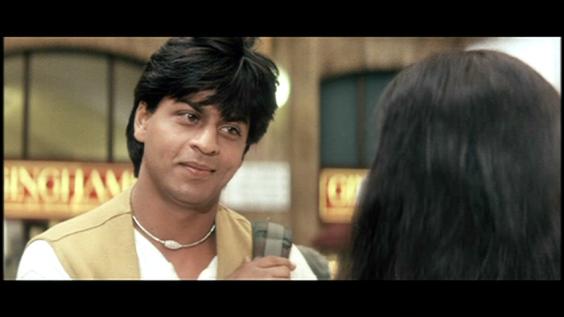
One of the best chapter here is an extract from her book on Dilwale Dulhaniya Le Jayenge, where she interprets the film is some detail, bringing in several fresh insights. Talking about the character of Raj, she writes, “He is the perfect blend of the modern and the traditional. He is progressive in certain situations and rigidly conservative in others. He plays by the rules but he also tweaks them. When Simran decides to keep karva chaut, Raj supports her. Karva chaut is a largely north Indian ritual in which married Hindu women keep a day-long fast, abstaining from food and water for the prosperity and longevity of their husbands. Feminists have long railed against this gendered practice, but the ritual continues to be immensely popular. Aditya (Chopra) who grew up watching his mother do karva chauth, puts a modern twist to it. Simran, the bride-to-be, decides to fast for her future husband. In her mind, of course, it is Raj and not Kuljeet. Raj doesn’t take the ritual too seriously – when Simran complains of hunger pangs, he tries to sneak her a laddoo. But as a token of love and solidarity, Raj also fasts...”


Anupama rightly points out how the DDLJ world is a largely male-driven one, where women have little power. She also makes a mention of one of the most terrific scenes in the film, involving Simran’s mother Lajjo who speaks about the continued sacrifices expected out of women. “The film most definitely recogonises this inequality between men and women, but affirms the status quo. Like Barjatya’s Hum Aapke Hain Kaun...! it establishes the importance of family over individual.”
The book also carries many of the author’s reviews of past and recent films.
Anupama’s writing is precise, with unmistakable irony and style. Shah Rukh Khan in his Forward of the book also makes a mention of it. "I may or may not agree with her view but I know it is honest. I like the simplicity of her writing. I like that it is never over-elaborate," he says.


The actor in his forward also mentions how Anupama is objective because she is an 'outsider' who became an 'insider' - much like SRK himself. SRK further recounts some interesting aspects of his journey to superstardom, and especially talks about his early days.

Since much of the contents of the book are from contemporary film history, it's not terribly revelatory in any sense. But Anupama's polished yet empathetic approach is what makes her writing stand apart. For that reason, this book is a worthy endeavour.

27 May 2011

City Of Djinns

Author: William Dalrymple
Pages: 339
Published in the year: 1994
Publishers: Penguin
Genre: Non-fiction/ Memoir


For Dalrymple, who has come to acquire the status of a formidable travel writer today, it was City Of Djinns that marked the beginning of his fascination with Mughal history. For the book, part travelogue and memoir, the author spent nearly a year in Delhi unravelling the city's archaeological riches. What looked like a fling with India soon turned into a lasting romance, and the Scottish author followed it up with two more books on related themes that became the centrepiece of his literary career - White Mughals and The Last Mughal. While the former is about the early relationship between the English and native Indians, The Last Mughal largely is based on events around the 1857 revolt and the ouster of Delhi’s last king, Bahadur Shah Zafar.

Both the above books were born out of City of Djinns. Dalrymple had visited Delhi when he was all of seventeen and was instantly under its spell. "It was so totally unlike anything I had seen before. Delhi, it seemed at first, was full of riches and horror, it was a labyrinth, a city of palaces, an open gutter...Moreover - I soon discovered - possessed a bottomless seam of stories, tales receding far beyond history, deep into the cavernous chambers of myth and legend," he says in his introduction.

The whole city, then, seemed to be an endless and fascinating journey of discovery to the author, who had already by then acquired a reputation as a stunning travel writer with his first book In Xanadu. Still only 25, Dalrymple brought with him a sense of adventure and a charming wide-eyed curiosity to Delhi that he put together in this elegant, lush memoir. Besides uncovering grand, epic stories around the city, the book is punctuated with delightful daily-life anecdotes that Dalrymple narrates with a mix of bemused exasperation and empathy. Many interesting character dot his domestic world. His land lady Mrs Puri, who likes to govern things with an iron hand, and his cab driver, Balvinder, a loutish, pan-chewing Punjabi fellow - are coloured with vivid, ironic strokes. Charmingly, Dalrymple was also newly married around this time, and provides a very flattering portrayal of his artist-wife Olivia, who has done the illustrations for the book. The maps and monuments she draws are really pretty, though much of the sketches have a distinct exotic, western gaze - man smoking hookah, an old cobbler, qawwali singers, a eunuch and so one.

The author slowly peels the many layers of Delhi, by tracing the antecedents of the city’s famous monuments. It opens up a long and bloody history of conquerors and blood-shed, of periods of glory and despondency, of exile and re-settlement. Darlymple’s journey touches upon the after effects of the Indo-Pak partition on its inhabitants, the Sikh revolt in the 80s. From contemporary history, he goes back to the Raj, and extensively covers the period which saw a rapid change in the British attitude to the natives. All this happened within a century. The Whites who came either as part of the East India Company or as scholars, were reverential to the Mughals. They imbibed the Orient culture, married Indian women.... But as the power of the East India company grew and the British conclusively established their rule in most of India, the equations drastically altered, and the natives were all shunned. The Anglo-Indians, in fact, suffered the worst blow, as they found no acceptance on either side. Dalrymple speaks to a few Anglo-Indians who survived that period, and their inputs are quite telling. Most of them consider themselves as full—blown British. One such old couple is Marion and Jeo Fowler, who describe with delight one of their brief visits to England. They talk about the great food, the picturesque landscaps and the sense of equality that prevails there. There is a hint of regret at not being able to live in a place they believe to be their right. “It was that Mrs Thatcher. She never liked Anglo-Indians. She made it very hard for us. All her rules and regulations,” they bemoan.

From the British era, the book travels back to the luxuriant Shah Jahan period, where a bloody battle for succession broke out between his two sons Dara Shikoh and Aurangazeb. It was also a period where the Mughals were at the zenith of glory and wealth. Yet, the author observes that this outward refinement in art and etiquette was a cover for some of the most crude and heinous of crimes committed.
Delving deeper into Delhi’s history, the author gives vivid portrayals of Ibn Battuta, a Muslim, Moroccan traveller, who wrote about his journeys and Tughluk Khan, one of the most barbaric rulers of the 14th century.

Clearly, Dalrymple summons up tremendous amounts of patience, as he painstakingly gets to the bottom of the city’s historical treasures. The entire endeavour brims with passion, and equally impressive is the maturity and restraint that Dalrymple brings to his excellent writing.
The author is seldom critical, except when he talks about the neglect by the Indian authorities of important archaeological sites or his harrowing experience at the customs. At other times, he prefers letting his ironic narration do the talking.
It need not be added then that any reader of City Of Djinns will view Delhi is a completely new light.

20 May 2011

Tagore's Naukadubi

Kashmakash(dubbed)
Director: Rituparno Ghosh
Starring: Jishu Sengupta,Raima Sen, Riya Sen, Prosenjit,
Stars: ***


In times when intelligent and original stories are so hard to come by, one naturally looks towards literary adaptations with some interest. Because even if they often disappoint in their final execution, they still come with a semblance of a plot. And if the adaptation is of a book written by Rabindranath Tagore, one is even more thrilled at the prospect. Tagore's reputation largely rests on his poems and short stories, but he was also a farily successful novelist. His Choker Bali was an artistic tour de force and was earlier made into a film by director Rituparno Ghosh. This time Ghosh chooses Tagore's other famous novel, Naukadubi that was written at the turn of the 20th century. Great changes were happening in Bengal, as in the rest of the country at this time. And much of this got reflected in Tagore's works.

Naukadubi has been dubbed in Hindi as Kashmakash, produced by Subhash Ghai to coincide with Tagore's 150 anniversary. Somehow, even though any endeavour that brings classic literature to the fore needs to be applauded, and Naukadubi has some definite strengths, it is a film that is closely tied to the context of its times. Chastity is an important concern in the film, so is parental influence. These elements are the chief drivers of the plot, and these may not necessarily find a resonance with today's audience, unless they can see it as art belonging to a particular social milieu.

And yet, it does raise some profound and timeless questions. It looks at our deeply engrained sense of tradition and morality and what happens when it is in conflict with the dictates of the heart. Each character goes through this conundrum, and deal with it according to their individual situations in life.

There is of course beauty and lyricism that come from the fact that Tagore was essentially a poet at heart. Novel-writing demands a certain analytical and realistic approach, but being a lyricist, he applied his grand imagination to real settings. Naukadubi is an example of a dramatic, incredible story, that almost seems like it was written with the intent of shaking up a complacent and custom-driven Bengali society. Though a popular fictional story, its critical reception has not been the most flattering over the years. Yet, it's not hard to see it as quite bold and progressive for its times.

Ramesh (Jishu Sengupta), is a scholarly young man in Kolkata in love with the beautiful and intellectually-driven Hemalini (Raima Sen). They intend to get married, but Ramesh is suddenly instructed to come back to his village by his father. When he arrives, he learns that his father has fixed his marriage with a poor widow's daughter. Ramesh's first reaction is to flatly refuse, but on seeing the widow, his heart softens and he agrees to marry. On the wedding day, their boat gets wrecked. On the shores, he sees a bride, Kamala (Riya Sen) lying unconscious. He naturally supposes her to be his wife, and they start to live together. He fights hard to forget his paramour and is gentle and affectionate towards Kamala. But he slowly learns that she is not his wife at all and there has been a misunderstanding. On Hemalini's part, she tries to get over Ramesh and starts to imagine a life with a country doctor (Prosenjit) whom she meets. Kamala too finds herself on the crossroads.

The theme is clearly about nature versus custom. Each of the characters is forced to momentarily bent to accepted tradition, but ultimately a satisfactory resolution is found. The boat-wreck in some ways could be a metaphor for nature asserting itself and ending what it deems as unnatural.

Hemalini and Kamala are two women who belong to opposite ends of the social spectrum. Hemalini has the previlege of wealth, education and an indulgent father - a desi Emma or sorts - while Kamala considers herself unfortunate and is subservient. Both experience the same kind of emotions, but their social background ultimately determines how they react to their situation.

The period details, decor and costume make for sumptuous viewing. And the music is simply marvelous. Here's a link to Manwa from the film, one of the most gorgeous songs in recent times (http://www.video.mobitowns.com/manwa-kashmakash-2011.html)

On the downside, Tagore's story uses too many coincidences at every point. The situation under which Ramesh agrees to marry also lacks conviction. Prosenjit's character is the most underdeveloped of the four. However, director Rituparno Ghosh seems to have done exceptionally well with the content at hand. There is tremendous grace to this film, and Raima Sen has never looked more ethereal. Though the emotional complexities don't emerge very well (and this could be a weakness in the original story), there is something deeply humane and dignified about its characters.