13 December 2010

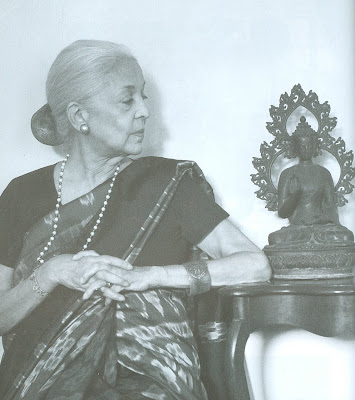
Leela - A Patchwork Life

Pages: 180
Price: Rs 450
Publishers: Penguin Vikings


The faintest memory one has of Leela Naidu is that of Anuradha, the haunting, virginal beauty in Hrishikesh Mukherjee's 1960s film with Balraj Sahni. There were a few more fleeting appearances from her on the screen, but by and large, she remained a figure known only to a close circle of friends in Mumbai, where she stayed till her death earlier this year.


Leela - A Patchwork Life is an autobiographical book, that captures some of highlights of her life - and there were many. She died before the book was published a few months back. She was 69. The multi-lingual, multi-cultural Leela was one of the most well-traveled, well-read people of her times, and French launguage in particular was ingrained into her system.
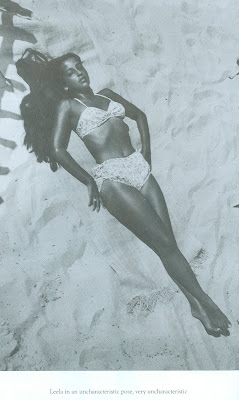

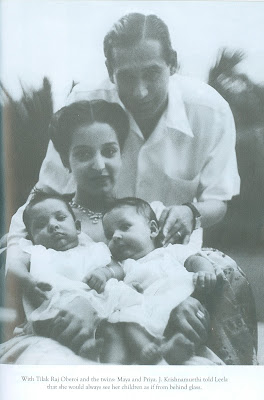
Born to an physicist Indian father and a French-journalist mother, Leela was thrown in the company of illustrious men and women very early on. Hindi films were incidental to her life. She acted in a few films, got married into a rich industrial family (Oberois), delivered twins, got divorced, married poet/writer Dom Moraes and stayed together for 25 years, until they separated. However, none of the personal tragedies in her life find a place in the book. In her prologue, she enumerates the incidences in just one sentence, but it unmistakably carries the weight of memory. 'I do not see what use it would be to recount my 'trials and tribulations', except to add to yet another narrative of feminine pain to the ones that are already extant."

If that was all there was to Leela's life - which she anyway didn't wish to talk about -- the exercise would seem pointless. If the book is still so readable it's because the memoir teems with wonderful anecdotes from a bygone era, where she came in close contact with some great luminaries of her time. Her parents were fairly influential in their fields, and Leela was privi to many of these personalities visiting her home from time to time. She remembers filmmaker Roberto Rossellini loving her mom's cooking and when Leela goes to Paris for a certain medical reason, she has his wife and legendary actress Ingrid Bergman for company. In one of the most interesting chapters of her life, she forms a close association with new wave director Jean Renoir, who teaches her some vital aspects of acting. In one of the episodes, she describes how Renoir got her to read a particular scene and led her through a series of exercises in what he described as the 'ifness' of the play. What if the character was such and such? The text was merely to be the framework and each interpretation could bring something new to that framework...

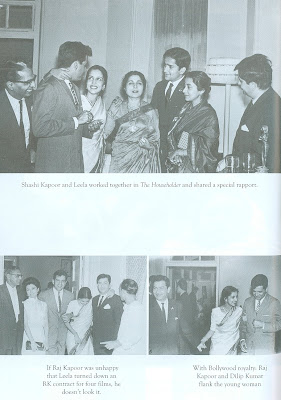
Obviously, her exposure to world cinema and her interactions with the masters had a bearing when she acted in films later on. In what is perhaps the most interesting segment of the book, Leela describes her working relationship with Ismail Merchant and James Ivory who made The Householder with her and Sashi Kapoor. Someone senior sees the clippings of the film and praises Leela for her good use of her toes in a scene where she is angry and on a hunger-strike. Leela had not noticed it at all. "I believe that if you know what one part of your body is doing, or you're planning what your eyebrows are going to do, you're not acting, you're modelling," she views.

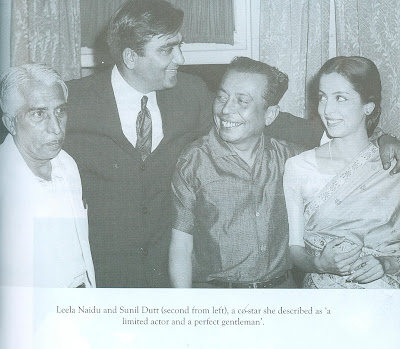
Once Leela approaches her teens, her luminous beauty is noticed by all. Raj Kapoor who she is told has the 'regretable tendency of falling in love with his leading ladies', is struck by her good looks and offers her a four year contract. Leela says she was never very keen on films. Yet, she accepts Hrishikesh Mukherjee's Anuradha and describes the experience as pleasant. She seems to have shared a bitter-sweet equation with co-star Balraj Sahni. She says he lend his gravitas to many films that didn't deserve it, and then goes on to tell us that for all his gentlemanliness, Sahni was not above 'trying his luck with her' The other high point was when Vogue mazagine listed as one of the five most beautiful woman in the world.

Leela's inherent delicacy of speech and elegance prevents her from ever turning vitriolic towards any known figure, but she nevertheless gets across her point, either saying it plainly or then employing clever sarcasm. The latter she uses for her husband Dom Moraes (not being able to resist calling him 'morose'), who was also her childhood friend. Leela talks about how she was his unpaid secretary for years, taking down notes for him and interpreting his 'mumbling questions' as he interviewed high-profile personalities all around the globe. One of them happened to be Indira Gandhi, who kept giving them monosyllabic answers.

The first half of the book is made interesting only because of some the famous interactions she had, otherwise Leela's language often tends to get stilted and there is the appearance of some dainty posturing as well. One theme that is repeated episode after episode is Leela's good Samaritan acts. So either she is fighting for the rights of the 'extras' on the film sets, or taking up some racism issue. Leela's concerns may well be genuine, and that is plausible given how she went on to make documentaries on a variety of socially relevant subjects later on, but her self-projection as a do-gooder gets tedious to read after a point. Leela presents herself in no better than in the best light possible always, which makes the memoir seem quite imbalanced.

But the book grows on you and Leela has many valuable insights to share along the way. Her observations of Indian film units - make-up men keeping their shoes in the same trunk which contains the cosmetics - or Leela finding her expensive clothes being returned in shabby condition after use - point at their callous disregard for others. "The film industry and I never understood each other," she writes finally.


The writing has its moments, and at 180 pages, the  book never overstays its welcome. The book was narrated orally to writer Jerry Pinto. People who know Pinto believe that there is a definite shadow of him in the writing. It seems very likely he anchored the material. But what you get in the end is an engaging book that takes you back in time and entrances you with the scents and smells of an antiquated time.
08 December 2010

Somerset Maugham A Writer's Notebook


Most of us who grow up with the vague idea of becoming writers sometime in the future or at least putting what one reads to good use professionally will admit to have maintained a note book. I, for one, have. And since I rarely revisit a book for a second time, and since my own retention powers are so woefully limited, I rely either on making markings -underlining the text or then often diligently jotting it down in pretty notebooks. If employed with discretion and intelligence, as Maugham would say, the habit is not without profit.

Somerset Maugham's The Writer's Notebook is a collection of his thoughts, observations, ideas that he gathered along his prolific writing career that lasted over 50 years. The author kept a notebook and would scribble away anything that caught his fancy as he travelled far and wide and met a great deal of characters (one calls them 'characters' and not 'people' because Maugham always saw them as such and was otherwise quite a loner in real life.) It's a practise he started when he was all of 19, and kept updating it till he was well over 70 years. Maugham explains that it was not vanity that prompted him to publish his private notebook, instead it was born out of the thought that he himself would have been thrilled if a well-known writer had came out with such an edition while he was embarking on a writing career.

But when Maugham actually made the notes, it was with the idea of putting the material to future use. So what you find are several brief descriptions of characters and places, and reflections on life, art and human character. I must confess I didn't read everything in the book and though I glanced every single page, I rested my eyes and got immersed only on topics that I was inclined to read about. It's rightly a book that is usually found as a supplementary part of Maugham's stunning autobiography, The Summing Up, because there is an expected resonance in both works.

The parts which caught my eye were about Russian literature, which Maugham doesn't have very complimentary things to say about. Because the collective body of Russian literature is so small, Russians know it with a great thoroughness, he piquently observes. Maugham is a bit bewildered at its over-estimation all over Europe, and believes Russian literature to suffer severely in the area of characterisation. He notes that even someone like Dostoevsky -who has other strengths - has all his characters as 'all of one piece' and as personifications. He says, "It is humour which discerns the infinite diversity of human beings, and if Russian novels offer only a restricted variety of types it is perhaps because they are singularly lacking in humour. In Russian literature you will look in vain for wit and repartee, badinage, the rapier thrust of sarcasm, the intellectual refreshment of the epigram, or the lighthearted jest. Its irony is coarse and obvious."

The other insight is on 'irrationality' in characterisation. Maugham says that though man is fundamentally not a rational animal, he/she feels dissatisfied when the persons of a story do not act from motives that we accept as sufficient. He references Othello in this regard, terming how all of Shakespere's characters in this play were highly irrational. Critics have of course tried to justify their motives, but Maugham sees it as a futile exercise. "The critics would have done better to accept the play as a grand example of the fundamental irrationality of man."

There are other observations of the 'value' of art, the purpose of life and many such philosophical musings. The book in many ways points at the evolving of a writer, through his insatiable need to travel, meet new people, be exposed to new sensations and finally give expression to it in his books. Insightful, stimulating and bristling with original ideas, The Writer's Notebook is a terrific treasure trove that takes you into the rich and ever-curious mind of Maugham who considered every thing he saw as material for his writings. His invention, imagination and sense of narrative drama did the rest!

20 November 2010

Chetan's next book in Diwali 2011

Chetan Bhagat who lent his support for the recently held literary fest in Mumbai-Pune announces his next book, besides talking about the mass market and the
3 Idiots controversy


As India's bestselling writer walks towards the venue for Literary Live! on the final day of the event at Lavasa, a township on the outskirts of Pune, we see a slim and trim Chetan. The author had mentioned last year that being a youth icon he couldn't afford to be unfit, and he seems to have duly worked on that. "Have I really lose weight," he asks the journos present, as we walk towards the greenroom before he can begin his eagerly awaited session.

This IIT-IIM graduate, featured by Time magazine as one of the most influential people in the field of books, has been significantly responsible for the rise of the mass fiction market in India. Chetan understands his contribution in getting young India to read, and thereby facilitating such literary events to get a receptive audience. "Otherwise literary festivals so far were only about writers discussing their works among themselves. That's not a convention. You need readers to participate," he says.

The success of his bestsellers, Five Point Someone, One Night @ A Call Centre, among others, were mainly responsible for opening the floodgates for the mass fiction market. However, this has also led to cheap imitations where a lot of trashy writing gets published. While one ought to be happy about the genre of Indian Writing In English finally expanding across segments and being more inclusive than ever, but without adequate filtration, isn't there a fear that it could bring down the overall standard of IWE? Chetan agrees that the market is getting flooded with all kinds of books, but he's not too worried. "Finally only the quality books will get sold, the others will dissapear," he says.

Earlier this year, Chetan took on the makers of 3 Idiots over credit issues, and got the better share of public sympathy and support. He's happy that the incident proved to be a watershed one, with Bollywood getting more conscious about giving due credit to its writers. "So many people within the industry called me and said they supported me. You can't cheat people in today's times. Whether it's a politician or anyone, if you are in the wrong, you will get caught and have to go!" he says.
Yet, Chetan wants to put the incident behind him and concentrate on other things. "Yes, my 5th book will come out next Diwali," he says, not willing to give away anything more on it.
Here's wishing him all the luck!

17 November 2010

The Kite Runner on stage

The stage adaptation of The Kite Runner that was presented by a New York-based theatre group proved too loud and mocking to capture the essence of Khaled Hosseni's celebrated story about friendship and betrayal


The idea of using popular literature as material for stage seems like a win-win situation. For a majority of those who aren't into reading, a theatrical adaptation of a book gives them easy access to a story that is worth knowing about. Similary, for theatre groups, the exercise is a worthwhile one, since there is always a ready audience waiting to see on stage a story they're already familiar with.

That has been the idea for New York-based theatre group, Literature To Live, and its 89 year old founder Wynn Handman, who started the institution 48 years ago. In the last 15 years or so, the group has been focussing on literature-based theatre in their 'Voices worth hearing' programme and have adapted about 15 books for the stage. The intention, says Chris Snock - teacher and organiser at the institute, is to get those who aren't big readers interested in literature. "A lot of our stage activities are for New York city school kids," he says. And Khaled Hosseni's bestselling novel, The Kite Runner was an obvious choice in this regard. This novel about life in Aghanistan and a tragic tale of love and betrayal, brutality and redemption has been a massive hit all around the world, and to US especially, after 9/11 and Taliban, it opened up a window to this part of the world. Says Chris, "Americans realised that Afghanistan has had a rich culture that dates back to 550 BC, which has been way longer than the five years of Taliban rule they know about."

At the start of the presentation, Chris was especially heartened that many in the audiences had read Hosseni's novel.
The performance was introduced as a particularly challenging one, where one single actor would be bringing to life the novel, enacting 10 different characters. The adaptation limited itself to the first half of the novel, about the childhood friendship between Amir and Hasaan, their ironic fates and the one act of betrayal that changes their lives. This is really the pivot in a novel that starts to get progressively melodramatic and contrived. But NYC-based actor Sohrab Wadia hits a rather discordant note as he attempts to bring the novel alive. For starters, Sohrab's exaggerated body language, tonal quality and overall presence just don't belong by a long stretch to the Afghan world. There's so much of the accented, yuppie New Yorker in him as an actor, that he never truly inhabits Hosseni's world. Also for some inexplicable reason, the writers and Sohrab together treat all the characters with half-mocking jollity which doesn't fit well with some of the emotional scenes. The script is relentlessly verbose, but Sohrab has great felicity with the language and has no trouble mouthing all the lines at one go. While he's not really able to enact Amir or Hassan satisfactorily, he's more convincing as Amir's father and in some of the other older parts.

The audience of course seemed satisfied with the performance, but when we asked Snock about the selection of actor, he admitted there were limitations. "We do the best we can in finding actors who can carry the spirit of the book. I do agree that Sohrab's own personality pervades heavily on the stage, but we've not had a problem with that whenever we've preformed in America. Perhaps, since the novel belongs to to the Asian world, the audience here will have a sharper eye about these nuances," he noted.

Sohrab, while talking to the audiences noted how he their intention was to be minimalistic and hence no props or lights were used. "Our founder Wynn Handman would not even let me use my hands too much and wanted me to keep it in my pockets, so as that audiences could be completely focused on the emotions," he said.

Undoubtedly, the stage can be a great vehicle to bring great literature to audience, to even enhance and illuminate the experience of the written word. Contrarily, it can also prove ineffectual or even injurious to the original work. Let's hope the good overrules the bad in this wonderful bridging of mediums.

16 November 2010

Literature Live! - the new lit fest in Mumbai

Following on the footsteps of the Jaipur lit fest, journalist-columnist Anil Dharker organised a four day event, called Literature Live in Mumbai that saw a decent turn out. The event didn't see the big players, but the fest is a great beginning towards wooing young Indian readers and infusing energy into the literary world as a whole

Bachi Karkaria, Anuvab Pal and Anil Dharker

For a long time, literary events have been indentified as elusive clubs, with only writers and a known circle of wine clinking literati participating in it. The reading public for Indian Writing in English and the Queen's language in general has always been a fairly niche one, making the prospect of literary conventions not entirely viable. However, things appear to be changing in the last decade or so, with the rise of the Indian mass market, and consequently the opening up of the desi publishing industry.
The Jaipur literary fest, held in the winter of January every year, started out tentatively, but has come into its own and is now attracting heavy-weight writers from all around the globe. It is within this context that Anil Dharker conceived and conceptualised Literary Live!, a four day lit event that was held in NCPA -Mumbai and Lavasa, Pune. "I always felt the city (Mumbai) needed a literary fest. We have a film festival (MAMI), we have various theatre festivals. What we lacked was a literary fest. We have a Marathi lit fest, but Mumbai is too cosmopolitan a city for it not to have a festival in English writing. The idea was to bring in national and international players and have them interact with our people and expose them to our readership," he says.
Prominent members of the local literati who took part in the event included poet Keki Daruwala, journalist and novelist Manu Joseph, poet and novelist Eunice D’Souza, writer Amish Tripathi and blogger Anupam Mukerji, popularly known as Fake IPL Player. There was also best-selling writer Chetan Bhagat, columnist Bachi Karkaria and screen-writer Anuvab Pal, who were part of the Pune sessions. A New York based theatre group presented a stage adaptation of Khaled Hoseni's The Kite Runner, performed by actor Sohrab Wadia. UK-based Matthew Sharp's unique story-telling on the cello also riveted audiences. The topics for discussion ranged from 'E-literature – here today, gone tomorrow' as well as thoughts on evolving cities and the future ahead for Mumbai. Here in Pune, Bachi Karkarai and Anuvab Pal spoke on aspects of Humour and kept the audiences in splits throughout. Bachi observed how many have asked her that her allusions and puns are difficult to follow and why she doesn't make it simple so everyone can understand. “I have thought about. But the joy it gives me when someone comes up to me and says they understood a particular reference or allusion, is tremendous. I want to keep the qualitative edge in my writing, even if the band of people reading my articles may be small,” she observed.

Anuvab Pal with Chetan Bhagat

The idea of the festival seemed not to keep it limited strictly to books and authors but to broadbase and bead together pieces of theatre and music into this literary necklace. A fair bit of social commentary was also part of the mix. This perhaps works well to initiate youngsters and first-timers into such a programme.
The big names in the literary world couldn't make it, but Dharker is happy that the first steps have been taken. Finding finances to put together a literature fest, a field that is largely viewed as too academic and elitist, was expectedly not very easy. "I would have loved to have V S Naipaul and Amitav Ghosh, but for all that money is required. The Jaipur festival too had a slow start, but in six years, it's grown. I began by forming a team. But when the finances weren't coming, I almost gave up on the project 2-3 times. But there is an obstinate streak in me which I didn't know existed until now, 'he smiles, adding, "Then some of the organisations we had approached for sponsorship agreed, and slowly things started to roll. Now, I don't see an issue with budgets in the coming years. Many cities and institutions have approached us to hold literary fests of these kind. So the foundation has been laid."

But Dharker doesn't want this to be a one off event, rather a movement that carries on year long. It would be interesting to see how literary conscious India gets in the time to come and that will ultimate determine the future of these fests.

11 November 2010

Barack Obama - Dreams from My Father

First Published in 1995
Pages: 442
Genre: Memoir


It was when Barack Obama became the first Black President of the Harvard New Review, a legal periodical in the 90s, that he took his first step towards a possible career in politics. There was a burst of publicity around the event, and a publisher offered him an advance to pen down a book on his life. The excitement was mostly to do with 'America's hunger for any optimistic sign from the racial front'. "...a morsel of proof that, after all, some progress has been made' - Obama notes in his introduction to the book which was re-published during his Presidential run for the General elections.

Obama was merely 33 years old when he wrote the book, a heartfelt memoir about a bright, young boy and his difficult initiation into a fractured world. Born as a black American, with a white mother, the young Barack is uncomfortable about confronting questions about his mixed identity.  To his sense of justice and fairness, the whole system of segregating people on the basis of skin colour is inexplicable and confusing. He is in denial about it for a long time, and cannot believe his identity as a Black American should prove to be an impediment in any way. When he sees instances of racism, both implicit and explicit, Obama grows pale and uneasy. All around him, he sees the other Blacks resigned to their fate, assured that nothing really will change for them and that they are all doomed to fail.

Though more privileged than the average Blacks, he still struggles with his identity - not knowing where he really belongs. It is at this point that Obama takes up work as a community man in poor black colonies. His decision is as much an evidence of his idealism, as much as a certain faith that change will always come to those willing to work towards it. Along with this dynamism, Obama also starts seeing within this task the complex fabric of a racist society and its disconcerting truths. Obama admits about being disturbed and in denial about his Black roots, seeing all that it implied. But he ultimately makes that difficult journey to Kenya -his father's home - to reconnect and uncover for himself the other half of his identity. The exercise is humbling and emotional for Obama, but he does get the closure he seeks.

The book is divided into three parts - one, about his 'Origins', then 'Chicago' which is about the work he carried out as a community man and 'Kenya' - where he visits his black relatives after his father's death.

The parts where Obama talks about his parents, his mother's second marriage to an Indonesian student, Loco and their relocation to Indonesia are all extremely engaging and the author displays a refreshing candour in these parts. Obama's descriptions reveal his warm affection for his mother, grandparents and step-father Loco, even if he doesn't shy away to mention their quirks and difficult traits. Family tensions, awkward growing up years,  all find a place in this memoir.
As he steps into adulthood, the questions of race, identity, and his future preoccupy his mind. For most part, he comes across as a loner, quite self-contained, not given to exaggerated emotions. Which is why when Barack finally cries over his father's grave or talks emotionally about his mother, you know the feeling is a deeply felt one.  But when he writes about other characters (friends, colleagues and relatives), there is a mild condescension in his tone sometimes, though Obama always avoids pointed criticism.

The book comes alive when Obama talks about his family. The portions in the middle where he describes his grassroots work are however quite tedious to read with many long-winding episodes and forgettable characters.  Even with the benefit of hindsight -where we know what Obama become - these parts are extremely dull and I ended up skipping many pages.

On racism, rather than specifically blaming the Whites, Obama chooses to view the situation as a human tragedy, where a community - after years of subjugation and abuse - had lost belief in its ability to make any real difference. Obama is at his most eloquent and effective as he describes the tortured minds of the Blacks, their desperation to escape from the quagmire of poverty, and their mixed feelings about those among them, like Obama, rising in the ranks.

 The book is sincere, but if this weren't written by Barack Obama, it might not have amounted to as much. There's nothing terribly new in the book and even as a coming-of-age story, there are only sporadic episodes that truly capture your attention. Obama, of course, has the skill of a writer. The book is painfully arid in parts, but overall Obama has the gift of narration and his sense for drama is revealed in the manner in which he crafts the story about his father, keeping the mystery around him till the end, leading to a powerful climax.

And of course, the book demonstrates most of the qualities one has come to associate with the President - graceful, eloquent with a generosity of perception but also somewhat emotionally detached.

-Sandhya Iyer

29 October 2010

Somerset Maugham's Theatre and Being Julia


Somerset Maugham before he turned into a full fledged novelist was an illustrious playwright. And even though he never got too involved in the workings of the theatre world of his time, he remained a close observer. And it is much of this he saw staying in the wings that made its way into the novel he wrote later in 1937.
Theatre or/and its 2004 literary adaptation, Being Julia (directed by director István Szabó), is the story of an exquisitely talented and alluring stage actress Julia Lambert and her trysts with various men.

So consumed is Julia with her aura as an actress, and such is her versatility at playing different parts, that she never stops being a performer even when she is not on stage. As she embarks on a spectacular career, Julia gets enamoured by her good-looking and industrious co-actor, Michael. They are a happily married couple for a while, but soon Michael's vanity and business-minded approach to everything starts to bore Julia. She is a mega successful actress on the London stage, and by 40, she has all that an actress can possibly aspire for - plenty of money, a fleet of admirers, a husband who looks after her career interests, and a teenage son whom she is content to see on and off.


Yet, Julia is a restless soul, always looking for short-term romantic adventures that will uplift her soul and send her heart into raptures. She's also acutely self-centered with a constant need for assurance about her desirability. Vain to an extreme degree, Julia has a compulsive need to feel loved, adored and highly valued by all. She returns all this attention with a charming superficiality, but with no great sentiment towards anyone. In fact, in Julia's mind, the lines between the stage and real have long blurred and she no longer can recogonise who she really is. Like her son Roger tells her once, "You don't know the difference between truth and make-believe. You never stop acting, It's second nature to you. You act when there's a party here. You act to the servants, you act to Father, you act to me. To me, you act the part of the fond, indulgent, celebrated mother, You don't exist, you're only the innumerable parts you've played...."

It is this struggle with conflicting identities and a fickle, restless but sparkling mind that prompts her to be on the look-out for instant gratification. Between flirting and keeping her wealthy, erudite lover, Charles guessing about her affections for him, she also meanwhile falls headlong in love with an American boy, Tom several years her junior. His smooth, handsome face and body evokes a great passion in her. Tom, on his part, is kicked about being seen with a celebrity and joins her to all her high profile parties. But soon, he gets attracted to a younger, upcoming actress, Avice Crichton and cold shoulders Julia. Infuriated and upset, Julia goes through a slump, only to recoup and assert her glorious celebrityhood.

In Julia, Maugham creates a memorable and life and blood female character, who is as despicable as she is delightful, as artificial as she is alluring and as capricious as she is charming. It's easy to read her as scheming and manipulative, but that would be a surface reading of this extremely complex woman. Her airy superficiality and self-absorption make her difficult to like, and yet, Maugham does not condemn her. He writes her part with stunning constancy and depth, and even though he depicts what is truly pathetic about her state, one guesses Maugham is quite taken in by her spirit and allure to let her slip into being anything dismal. He allows her a grand comeback,from the brink of despair.

When a novel is an exploration into the psyche of a singular character, with no real hook, it can become difficult to adapt on screen. But Being Julia turns out to be a beguiling film, all thanks to a glorious performance from Annette Bening, who keeps you riveted to her from start to finish. She is beyond beautiful, and in spite of the narrative being condensed to suit the film format, Bening captures Julia perfectly, and one dare says, makes her perhaps more scintillating than she was in the novel even. But not everything else in the film is perfect. The Tom-Julia affair lacks the adequate chemistry in the film. Shaun Evans, as the American cad is only half convincing, and many of the scenes between him and Bening seem awkward. Ditto with Jeremy Irons, who plays Julia's practical-minded husband, Michael. The book recogonises him as vain and boring, but Maugham infuses in him a masculine charm that is entirely missing in the film. But apart from that, the film takes all the best scenes and dialogues and does a neat job of it. The novel reads the character of Avice Crichton - the struggling new actress on the block - rather differently from how the film uses her. The character is far from comical in the novel, and is quite an undistinguished character, except for the fact that Tom likes her and thinks of her as a perfectly honorable choice for him, which Julia is not! The problem is the film treats Crichton as a buffoonish wannabe, and hence Tom's affection and so called 'respect' for her does not ring true. Yet, the climax in the film, and the scenes leading upto it, are all entertaining and Bening makes it every bit worthwhile.

16 September 2010

Thoughts on Of Human Bondage


Somerset Maugham's Of Human Bondage (1915) - his most intimate and autobiographical novel - was written by the author over the course of a few years and was a cathartic, purging exercise for him. Many tend to believe that the novel revolves primarily around a masochistic relationship that the protagonist has with a woman. However, Of Human Bondage is much more than that, and it's not until very later in the novel that the above episode actually takes place.


The novel is one of Maugham's longest (almost 700 pages) and captures the many shades of his life: an uneasy childhood, frustration at struggling to find the right calling and then finally, falling into an abusive relationship that almost leads to his ruin. While not all the episodes are autobiographical, the emotions are all his. Maugham was at the height of his popularity as a playwright when he set out to write this novel. His career as a novelist had taken a backseat and not even Maugham though he would digress from writing plays. But he did. Of Human Bondage wrenches out a story of deeply fractured emotions and inner conflicts experienced by an artist and an emotional man, which Maugham felt compelled to write about. He wanted to get it out of his system. He often said that he wrote because he couldn't help it. Which is what makes the novel one of the most intimate and searingly honest books ever written.
Maugham never really went back to the stage. Now that he was affluent, he returned to his first love - writing novels, short stories and essays, where he could be himself.

When the novel was first published  it was met with a certain ambiguity among critics. For a while it looked like the novel would be doomed to obscurity. Then writer Theodore Dreiser  wrote a stunningly positive review of the novel and suddenly it stoked a good deal of critical and public interest. Dreiser said, "Here is a novel of the utmost importance. It is a beacon of light by which the wanderer may be guided. . . . One feels as though one were sitting before a splendid Shiraz of priceless texture and intricate weave, admiring, feeling, responding sensually to its colors and tones."

Over the years, Of Human Bondage has gone on to become Maugham's most famous novels. The first part of the book is almost entirely autobiographical and is engrossing from the word go.


Maugham had a difficult childhood after losing his mother when he was a little boy and being sent to his childless uncle and aunt.  Likewise in the novel the protagonist, Philip Carey finds himself desolate staying with his uncle, a vicar who is overly religious and cautious with money. The aunt who has never known a life beyond meekly serving her callous husband is well-meaning and affectionate towards Philip. Given his circumstances, Philip is prepared to be a good Christian and follow the path prescribed by the Lord.

However his first exposure to the outside world as a boarding student is an especially painful one.  Philip has a club foot and limp, and when children studying with him cruelly tease him, it makes a permanent scar on his young heart.  Philip grows up insecure and conscious. To him, his club foot is a reminder of his inadequacy and he blushes every time someone makes a reference to it. There's a heart-wrenching scene where Philip - with his absolute belief in God - fervently prays one night that he should be rid off his club foot and be made normal the next day. As it turns out nothing happens and therein are sowed the first seeds of Philip's disenchantment with religion.


The next big hurdle for him is to find his calling. His uncle and aunt want him to either enter the Church or take up something conventional. Philip tries accounting for a few months but he finds it torturous. He has a talent for sketches and when a few people praise him, he is spurred on and decides to go to Paris and become a painter. His uncle is outraged and strongly protests, but after a few acrimonious exchanges, Philip has his way. This is quite autobiographical. Maugham has said about himself that though he was shy and a silent child, he was also cunning and finally always got what he wanted.


 Maugham's description of his growing up years is compassionate yet ironic, not only in the description of other characters, but also Philip, who is his alter-ego. As is the case often, Philip in the bloom of youth, full of hope for the future tends to look upon his middle-aged uncle and aunt with a smug condescension and believes that theirs was a wasted life. At this point, Philip has grand plans for himself and intends to attain greatness. When he reaches Paris, he is initially thrilled to live among artists listening to various theories all day. It makes him a more open person and many of his moral shackles loosen up. But he is still unable to settle down as a painter. His works are considered intelligent, but nothing extraordinary. As a senior painter tells him, 'It is cruel to discover ones mediocrity too late in life'.


Philip's funds start running out and he is nowhere in sight of earning through his art. Here, the life of his acquaintance, Fanny Price holds an uncomfortable mirror to what his own life could degenerate to. Fanny is a zealous artist but with zero talent. Ultimately she dies of poverty. This works as a catalyst in hastening Philip's decision to give up art and try something else. He is again lost and tortured.

Quotes Maugham,"It is an illusion that youth is happy, an illusion of those who have lost it; but the young know they are wretched for they are full of the truthless ideal which have been instilled into them, and each time they come in contact with the real, they are bruised and wounded."


Philip decides to take up medicine and it is while studying that he encounters a waitress called Mildred. Her contemptuous look haunts him ,and he desires to possess her. She agrees to go out with him and soon Philip finds himself madly in love. She is vulgar, commonplace and not at all good-looking yet Philip cannot get rid off his obsession. He spends freely on her  though he has very little money. She does not love him and at various points goes off with other men who in turn leave her in the lurch. Philip still craves for her and does everything she might want,  including providing for her child (another man's) when she is in dire straits. Ultimately this relationship brings Philip to the point of utter despair.


He is left penniless and has to take up work as a common worker in a shop. At this point, another revelation comes upon Phillip. Following the death of both his uncle and aunt, he realizes that life is ultimately meaningless and we make our own little designs to keep ourselves happy for as long as we live. Every little episode is merely a curve in the design of life. This idea unburdens him and he feels elated again.


This learning curve ultimately comes to its logical conclusion when Philip settles to marry Sally, the daughter of a poor worker whose family was exceptionally kind to him when he had no one to go to.


Of Human Bondage tackles several themes and is an extremely rich and layered exploration into the human psyche (though it is unduly long and some episodes are extremely stretched out). Its greatness lies in the fact that even if the story is close to Maugham's life, the emotions are all tragically universal and gently touch upon deep-seated complexes we all suffer from. 

Many believe Philip's club foot could be a reference to the author's stammering. But many others believe it is an allusion to his homosexuality which he could not reveal given the time and age when such a thing was looked upon with derision. In fact, his masochistic relationship with Mildred many feel, alludes to a certain homosexual partner the author had. There could be some credence to this given that Mildred is described like a man with no attractive feminine features. She is bare-chested. Yet, this is merely in the realm of speculation and I wouldn't be too bothered about it, except that the incident comes quite abruptly in the book. 

What makes me suspect that it could be a slice from Maugham's own life is the surreal nature of the affair. Reality is very often much stranger than fiction.  Fiction is often far more predictable when compared to the complexities of the real world.

It's never easy to understand why Philip would fall for a woman without a single redeemable quality. Also, up to this point, Philip never comes across as someone who is wholly deprived of female attention.  In fact, he rejects a few women. His attraction for Mildred is sudden and unexplained. And yet, broadly, it suggests how human complexity can manifest itself in strange ways, and Philip is certainly a complexed man.

His relationship with Mildred underlines Philip's inner need to be humiliated and abused. His feeling of inadequacy - apart from his club foot - compounded by his non-success as a painter and general sense of despair - perhaps make him crave for a relationship where he can suffer. In fact, on various occasions, Philip brings this suffering upon himself. He knows Mildred's character and yet he introduces her to a handsome friend of his and soon enough they end up in an affair. Philip even pays for them to go on a vacation. His addiction to the affair continues, and only acute poverty forces him to get over this destructive relationship. In the middle, he even rejects a perfectly healthy relationship with another woman, Norah and goes back to Mildred. As a reader the Philip-Mildred relationship might seem puzzling, but if you've ever obsessed for someone who didn't return the favour  or blew hot and cold, it might not be so difficult to identify with Philip's servile state.

"He did not care if she was heartless, vicious and vulgar, stupid and grasping, he loved her. He would rather have misery with one than happiness with the other."

The other possible reason why Philip clings to Mildred and suffers her could be to feed his own flagging self-esteem by being in a relationship with a woman so lacking in class and character. In an odd way, her deep flaws and ugly behaviour make him feel better about himself.  He remains with her not because he has affection or respect for her but because of the inherent volatality and emotional violence of the relationship that his masochistic heart seeks. I tend to believe this theory because Maugham has captured with devastating accuracy this very emotional trait of human beings in some of his short stories.

One of the main themes of the novel is about the damning nature of love. In many ways, it advances Maugham's ideas on love, namely how one partner loves and the other lets themselves to be loved. "And the important thing was to love rather than be loved" In a twisted way, every character in the novel is consumed with a feeling to love, and are callous to those who love them.


Maugham opting to go for a conventional ending for his protagonist might appear contrived, but it also signifies the emotional maturity of Philip who this time round does not refuse Sally (like he did with Norah), even though he does not love her. He realizes by now the temporariness of life and how it wouldn't be so bad to make a design of being married with children. Once the limitations of life itself become clear to Philip he takes a more charitable view of himself and what he aims from his future.

As lucid as ever with its controlled irony and sardonic observations on life, Of Human Bondage rightfully deserves its place among the best in literature, though I would hesitate to rate it as Maugham's absolute best. Sure, there is immense emotional power in the writing and great philosophical insight, but that is true of much of his other works as well. But nevertheless, this is a creative tour de force.


07 September 2010

Review: The Crimson Throne

Author: Sudhir Kakar
Publishers: Penguin
Published in: 2010


Sudhir Kakar's semi-fictional period novel, The Crimson Throne takes a fascinating event in Mughal history, and intimately looks at it from the perspective of two foreign narrators - the italian Niccolao Manucci and Frenchman Francois Bernier - both of whom were real-life figures who were in fact part of this mid-17 century Moghal setting. The event in question is the war of succession between Shah Jahan's two sons - the liberal minded, Sufi-inspired Dara Shukoh and the fanatical Aurangzeb. Dara was the clear favourite of his father and everyone expects him to be the heir apparent. However, various elements conspire against him, and as one knows it was Aurangzeb who ultimately became Emperor.

The entire novel is divided between the observations made by the two foreigners, and as a reader, you share their sense of wonderment, amusement and outrage at different points. This is a time when India was divided into different kingdoms, and the Mughals were absolutely at the pinnacle of their reign. The threat of British invasion was a far-fetched thought and most foreigners viewed India as a distant, exotic land where there was plenty to see and experience. Among the two, Manucci is intrigued by the tales he hears of India and makes the journey from Venice to Goa. He hears that European healers are privileged over the local hakims in Moghal courts and is eager to learn the secrets to some rare potions. By sheer luck and good graces - as he admits himself - Manucci is able to entrench himself in the Dara Shukoh camp. He narrates with passion and poignancy his visits to the harems, where beautiful women (the concubines of the Moghal nobels) are a frustrated bunch with little or no sex (because there are so many in number!). Eunachs are used to guard the harems and very harsh punishments are heaped on women involved in any sexual misconduct. Manucci - being a healer- is one of the rarest of rare men allowed entry into the harem. He describes how he would often feel a soft kiss planted on his palms, as he went to check the pulse of an unwell woman from behind a veil.

Bernier is a scholar, and perhaps more rigid. He is distant and slightly contemptuous in his descriptions of Indians. But he gets close to Shah Jahan's foreign minister Danishmand Khan, the man who proves decisive in the end.
For most part of the book, it is impossible to see the two narrators as separate voices. Their distinct personalities don't emerge until much, much later, but thankfully, the central story does not suffer because ultimately the subject is focussed on the Moghals. From the ostentatious lifestyle led by the Moghal nobels (some rubbed the precious rose water on their horses everyday, the footwear of the nobels were studded with gems and precious stones, the most obscenely lavish parties were thrown and there was no limit to the number of women that the Omrah's kept adding to their harem) to the Hindu-Islam divide, there is much that is observed and astutely noted down by the two narrators. The Hindus were called idolators, and they were considered inferior in status to the Muslims. A Muslim of the lowest rank would not fathom getting his daughters married even to a high-class Hindu. On the other hand, there were several instances of Rajput kings giving away their daughters to Moghal kings - one is instantly reminded of the Jodha- Akbar situation.

It is only when Shah Jahan's health starts deteriorating and murmurs for a new heir begin that the narrative voices start to take on divergent paths. Manucci brings out the various qualities of Dara Shukoh, and the fact that he came closest to his grandfather Akbar in his religious tolerance and aesthetic liberality. On the other hand, Bernier takes a slightly opposing position and points out how Dara was an extremely irascible and tactless person, and was unpopular among those who thought Islamism would come under threat if he took over the reigns. Also, Bernier describes how Dara was an extremely superstitious person, and would not move a finger without his astrologers guiding him. Similarly, you get a twin perspective of Aurangazeb. Manucci sees Aurangazeb as a cruel dictator and religious fanatic, who uprooted every hurdle in his path without the least compunction.

Bernier, on the other hand, prefers to look at Aurangzeb's stead-fastness and ability not to get ruffled easily. Also, his ambition as we see, is less for self-aggrandisement and more because he’s a staunch upholder of Islam.
The writing style is lucid, and the ornate sentences go well with the mood and setting of the novel.  Sudhir Kakar's novel essentially proves useful in seeing from close quarters a significant time in Moghal history and how its course radically changed. The Crimson Throne is studded with several period details, and for that reason and more, is an engaging read.

10 August 2010

Agatha Christie's Absent In the Spring


Agatha Christie we all know as the queen of mystery novels. However, the more unknown fact about her is that she wrote six novels on love and relationships under the pseudonym - Mary Westmacott. By that time, her reputation as a crime fiction writer was growing and both, the publishers and perhaps even Agatha didn't want to tamper with her set 'persona'. And hence, she took on a different name under which she published these books.

Absent In The Spring tells the story of a smug surburban housewife, Joan Scudamore, who is returning to London after visiting her married daughter in Baghdad. The setting appears Edwardian. A missed train, followed by torrential rains, delays her journey by a few days, forcing her to spend the time at a rest house in the middle of a desert. With no company at hand and having exhausted her stock of books, all she can do is let her mind wander. Decorous and straight-laced, Joan has come to pride herself on being a great wife and mother. She is convinced that she made a success of her life. Her smug attitude also makes her narrow-minded and discompassionate about many things. She tends to look down upon anyone who does not fit into her idea of how one ought to be leading their life. She pities them, and uses their 'failed' and 'sad' existence to feed her own self-esteem.

'I thank thee, Lord, that I am not as this woman.' .....
She had prayed that night at the railway rest house wrapped in that spurious mantle of superiority.


However, as she spends more time by herself, the rose-tinted glasses slowly start to wear thin and she wonders whether she has stiffled the dreams of her near and dear ones, in her persuit to keep up the right appearances. Many doubts start to cloud her mind. Did she pressurise her husband to join their family law firm, when his heart was really into farming? Were her daughters happy with her, or did they hate her interfearing ways? Why is it that everyone warmed up to her husband, but not so much her? Did her husband, who she always thought to be devoted to her, actually fall in love with one of their family friends?

Joan, having led an cushy life, and a fairly active social life, cannot handle the sudden feeling of being left alone. She gets restless and all kinds of thoughts enter her head. By the end of her stay at the rest house, she is convinced that she has been extremely unfair to her husband and fervently hopes to make amends. The anti-climax reveals how nature cannot be build or broken in a day.

It's a slim book and a very quick read. The story is engaging, but not particularly layered or original. Joan - decorous and dull - comes close to the character of the strait-jacketed May in Edith Wharton's Age Of Innocence. Similarly, the relationship shared between Joan's husband, Rodney and their common friend Leslie Sherston vaguely reminded me of the Melenie-Rhett relationship in Gone With The Wind.
Also, the author wastes no time in conveying to the reader what exactly she thinks of her protagonist. It's all laid out bare too soon so there isn't much left to discover about Joan. Also, one feels a certain lack of subtlty in the narrative, with the overuse of irony.

But it's still a story that connects and rings true.

19 July 2010

The Counsel Of Strangers

Author: Gouri Dange
Pages:169
Price: 250
Publishers: OMO


Pune, which cannot yet boast of any English-language writer of repute, might just be on the threshold of getting one. Gouri Dange, who many in the city know as a witty columnist and counsellor, makes an assured second splash into the pool of Indian fiction with the launch of her new book, The Counsel Of Strangers. I will admit I was overall underwhelmed with her debut effort, 3 Zakia Mansion - a dark portrait of a Muslim woman and a long-drawn struggle with her nasty in-laws. I found it morose and melodramatic, even though I was blown by the emotional power in the third act of the book. Nevertheless, it clearly established the author's proficiency with her craft and language. And with The Counsel Of Strangers, she opts for a less tricky subject than 3 Zakia Mansion. The Counsel Of Strangers is really a book of short stories (more on that later). But the result is far more promising and overall, this makes for a thoroughly riveting read.

The book is about six distressed strangers, who dawdle away from a wedding that is taking place at a resort, to spend some private moments with themselves.
Each one is going through a transitional phase and looking for solutions. The darkness and the comfort of strangers allows them to talk about their lives. The first story is about a 60 plus retired man, who is spending time with his daughter and son-in-law in California. He's not unhappy, but there is a sense of loneliness creeping in. "You'll know when you get there... that uncomfortable feeling of being treated dutifully, but with little interest," he says. He meets a smart, 50 year old woman with whom he establishes a friendly, warm relationship. She is separated from her husband, he is widowed. When they speak to their respective children about this 'special person' , they are appalled and disgusted. This story, along with almost all the other ones, point towards the 'pigeon-holing' of people into specific roles and expectations.

The second story is about a young boy, Karthik, whose life gets greatly altered after his parents go through a bad experience on account of his elder brother, Vishwas. Karthik is tired of living a censored life, with his paranoid family watching out minutely for any tell-tale signs of 'weirdness' in his behaviour. A bit long-drawn story, but engaging nevertheless.

My absolutely favourite story is Anandi-Mohini. Personal and revelatory, it intimately tracks the journey of a strong-minded woman, as she comes to terms with the breakdown of her 14 year old marriage. That follows another unwittingly funny episode involving a prospective husband. There is plenty of pathos in the story, and it's clear that much of it is very close to the author's heart. But the story also sparkles with charm and ironic wit, because after the initial shock and sadness, the character is able to see her situation with bemused detachment and the ludicrousness of it all.

There's an especially telling part where she describes the aftermath of her divorce. Her friends – well-meaning and otherwise - come up with various reasons on why the marriage failed. For a while, her self-esteem suffers, until she sees the absurdity. “And these are just some of the many theories of friends and passing strangers as they drove gaping, slowly, past the accident site of our marriage. It takes a while for you to gain the wisdom to discount all of this as their projections of their reality, and not your truth at all.”

The other really wonderful story is of a Christian nurse, who wants to give up her profession after serving patients and looking after sick bodies for years. Now a plump, middle-aged woman, she wants to go back to her home-town in Kerala and live with her family. But here too, she is expected to take on the role of the nurturer.

The last story is about a professor mother who finds it embarrassing that her only son should get into Bollywood script-writing after studying at Haward. Her intellectual snobbery, as others call it, prevents her from accepting her son's choice of career.

The stories are all very readable, and even when some of the situations give a sense of deja vu, the author's quirky narration, keeps you engaged. I personally enjoyed the story of the nurse and Anandi-Mohini the most, but Gouri brings her sensitivity and sharp understanding of human nature to every situation and character. The book - through its characters - suggests how life is in a constant state of flux and in spite of its corrosive nature, holds the seeds of regeneration and hope.

There's something to be said about the style and tone of the narrative. The word 'contemporary' is generally bandied around too much. But The Counsel of Strangers is genuinely 'today's book' and talks to 'today's people' - and by that I don't mean the new generation only. The book covers stories of people from various age groups (thank god!), and the scenarios and concerns are all relevant and relatable. The words she uses (free use of all Indian languages, short forms, blog terminologies... ), the clever phrases, the references to films and books - all bring a chuckle and a nod of familiarity. In that sense, the book gains tremendously from having such a receptive writer.

Criticisms? I couldn't buy for a minute people confiding such personal stories before strangers. The author inserts a few sentences about a beer being passed or food being ordered in between each story, so as to keep reminding the reader that there is a common setting, but it appears too forced. Also, earlier there was Chitra Divakaruni's One Amazing Thing, where the characters get stuck in a building after a terrible earthquake and reveal stories about their lives to temporarily forget about their impending fates. I found that setting eked together with as much awkwardness. This template obviously comes from Canterbury Tales, but the vital difference is that in Chaucer's 14th century book of verses, the characters are traveling companions who are asked to tell a story - any story. It could be about their lives, but there's no way to know. Now, that is more plausible situation I would think.
In The Counsel Of Strangers, there characters could well be contemplating about their lives at the airport lounge and it wouldn't have mattered.

The other niggling problem I found is that the authorial voice is quite strong here, in the sense that the author's penchant for irreverence and sharp wit shadows every character and situation, expect maybe that of the Nurse. And this feeling is heightened because every character narrates in first person. While this ensures that the whole book is kept interesting, it hurts the characterisation. Gouri Dange beautifully inhabits the minds of a few characters, but the result is slightly awkward in the case of the old man, where it appears like the author is speaking on his behalf.

Yet, The Counsel Of Strangers works wonderfully enough for what it is. It sparkles with insight and intelligence and makes for a very entertaining read. The book abounds in such original and piquant metaphors, and the writing in general is so adept, it should comfortably establish Gouri Dange among the A-list Indian authors in the country.

-Sandhya Iyer

PS: The full form for 'OMO books' under which Gouri has published The Counsel Of Strangers, is 'On My Own' The author chose to self-publish after being distressed with the 'step-motherly' treatment accorded to lesser-known authors by major punblishing houses. Hence the wry and clever name - OMO!

06 July 2010

Balancing Act by Meera Godbole Krishnamurthy

Author: Meera Goldbole Krishnamurthy
Pages: 236
Publishers: Zubaan, Penguin
Price: 250


Motherhood is easily one of the most beautiful and transformational experiences for a woman. Everything else takes a backseat as she lets herself be consumed by its infinite pains and pleasures. Her career, which perhaps defined her identity and image until then, suddenly seems like a lame reason to step out and leave one's gurgling, stumbling bundle of joy. Every idea of feminism and self-identity is submerged under the deep sea of love that flows from her heart, as the life-giving, nurturer in her takes over completely.

Balancing Act captures this deep bond that a young mother forms with her two tiny tots. She's a harried but happy mother, who glows around the sacred and smug circle of her domestic life. Changing diapers, tucking in the kids in their beds with comforters, making star-shaped pastas and filling up juices in their fancy water-bottles , painting glittering nail polish on their tiny feet, playing with toy cars - it's a never-ending cycle of duties, which she performs with sacrosanct diligence and delight.

She feels privileged to be a mother. To an outsider, Tara Mistri touching 40 has a comfortable life, where she's a stay-at-home mom, with a supportive husband, Roshan who earns well, and travels often. Yet, she's disturbed when she sees herself being referred to as a 'housewife' at socials dos. People are baffled to learn that she does not work inspite of her high educational qualifications and professional achievements. She rues the fact that motherhood is no more a justifiable reason to stay at home, not just in America -where she lives - but even among her friends and relatives in India. Having been out of touch with the professional world for long, she feels constantly on the edge. Unsure and confused, Tara feels she may have been more suited to her grandma's times where it was natural for women to do nothing besides raising up children and minding the home. In today's changed times, when motherhood is just one of the different wonder caps that a woman dons, suddenly she seems like a mis-fit and traditionalist.

Tara had studied architecture and is deeply influenced by the thoughts of Louis Kahn, who built the Salk Institute for Biological Research in California. She stays at a stone's throw from the place, and sub-consciously wants to replicate the same perfection of the structure in her own life. Tara's pet peeve is a spirit Yakshi – her alter ego – who keeps prodding her to get back to work. Tara sends her resume to a few firms and even attends a couple of interviews. This is more to assure herself that she still has what it takes to make the cut than anything else. To add to her trouble, her attractive bachlorette friend Sophie comes to stay with them. Tara's hubby is drawn to her and finds in her happy demeanor a welcome contrast to his own wife.

All these mental conflicts that the protagonist suffers touch a realistic chord. However, the parts involving Tara and her husband seem superficially tackled. The episode related to her hubby getting drawn to Sophie does say something about the plight of neglected husbands, as mothers get preoccupied with kids. But this too isn't treated with any particular depth and the scene where Tara confronts her friend at the dining table, 'What are you doing with my husband@" seems overly dramatic and awkward given the otherwise subtle and fairly nuanced tone of the book.

Tara - as protagonist is not a very likable personality – as is the case with most women who turn motherhood into an obsession. In the end, there are no definite solutions because the issues are vague and complex. The only thing that the novel perhaps suggests is that a perfect balance can never really be achieved and it need not become a cause for so much heartburn. Each phase can be enjoyed for what it is.

Meera's writing is lyrical, artistic and quirky. The world she creates is so vivid, you can almost smell the baby powders, lotions and milk. The use of architectural terms in the novel - with many quotes and theories – adds much novelty to the narrative as well.

All round a good debut that succeeds without trying too hard.


-Sandhya Iyer


Interview:

1) Were you always interested in writing, or did you take it up because you wanted to express your thoughts on something that was close to your heart?

Architecture, painting, sculpture, making quilts, writing -- all these creative arts which I have explored have a common language with many overlaps. I have always loved books and the places they can take you. Over the years, I found myself interested more in the theory and critique of architecture than the practice of it. That being said, I don’t think you can become a writer (or anything, for that matter) overnight, to paraphrase one of Louis Kahn's architectural teachings. Before embarking on this journey, I participated in several writing programs and workshops at UC San Diego, Stanford, and the University of Iowa. Each medium has it's own specific art and craft, but I hope that some of my artistic sensibilities have crept into my writing, which was the vehicle for this particular story.

2) I'm sure most people have asked you this. How autobiographical is the book, and what parts of it do you relate to most?

Tara and I have many similarities, it's true. We’re both architects, have two children, and are married to husbands with demanding careers – but so are many women out there. The details may differ, but in spirit, our stories would be the same. I think one always starts with what one knows, but the beauty of fiction is that it can transcend the personal to become universal. Fiction is most convincing when it could be real, even though it is not. There is always a danger though, in assuming that a first work is more autobiographical than it really is! I relate to all my characters and all their dilemmas, because to write fiction, you need to inhabit it in such a way that it becomes real to you and consequently, to the reader as well.

3) Given that you are a mother, how difficult was it to take time off and put together the book. How long did it take you?

I started writing this book as a series of vignettes nearly ten years ago when my own children were very young and I had short, staccato time spans in which to write. Over the years, there were innumerable drafts and many formats that I discarded, adapted, and re-worked. The book took this form only when the idea of using the Salk Institute and the life and work of Louis Kahn as the structure for the novel came to me after a critique at the La Jolla Writer's Conference in 2004. And when the Yakshi showed up from the netherworld to question Tara’s every move, I knew we were in for a good ride!
When the children were older, for two years in San Diego, I set myself a strict writing schedule, Monday to Friday 9 am to 2:45 pm when I would stop to go pick them up from school. That was when I completed the first draft of the manuscript. And then there were always the late nights, when I work best...fortunately, I'm not much of a sleeper! The much harder part was finding the psychic space in which Tara and her world would exist. That's the toughest part about writing fiction - to be able to remove yourself from this world to bring to life another - without constant interruptions.

4) Her act of making bricks and writing words on it and leaving at differen doorsteps and random places is perhaps her own way of igniting a silent revolution for in the interest of women like her. Was this a literal act by Tara where she drops off the bricks or was it in her mind? And what kind of bricks are these? i'm sorry if I missed out some reference...

Louis Kahn asked the seminal question, “What do you want be, brick?” He was suggesting that in order to respect the true nature of a material, you must use it so that it retains its individuality but expresses its essence. For example, you would not use bricks in the same way as you would use concrete. Similarly, Tara is trying to define her true nature, separate from what society or feminism or her friends tell her, and I thought it would be interesting to take that literally, but also to an extreme level by giving her a darker side and having her engage in a social experiment where she challenges the politically acceptable and speaks for the unspoken through her known medium, the vocabulary of architecture.
And bricks are such potent symbols anyway: they build, they can destroy, and bricks, if they are Legos, almost define childhood, don’t they? So the metaphor of the brick was the perfect vehicle for building, designing, and addressing the question of Tara "rebuilding" herself. Just as architecture needs to be in the public realm, motherhood too is a part of the social fabric. So Tara had to make her statements, to practice her personal architecture, so to speak, in the public realm.

5) Most women find it tough to pursue careers for a few years after child--birth. But sooner than later, they want to get back to work. Things are seldom easy for them when they want to make a comeback. They seem to come with a 'baggage' which the professional world does not view kindly. Not many women have the luxury of family support or servants. How do you think this uneasy equation can be better dealt with, if at all?

You are absolutely right about this perception of the "baggage" of motherhood in the professional world. I believe that motherhood is and always has been a joyful act, a creative and large journey, which is not to say that it is without frustrations, of course, but we seem afraid these days to speak of the joys. May be because motherhood – and by extension, the “housewife” – has acquired such negative connotations, been devalued and degraded as the lesser choice. We feminist-mothers, what I call the “femimoms,” need to reclaim the unabashed and unapologetic nature of motherhood. I think if we embrace motherhood as another equally vital part of being a woman, it may help to balance the equation with a career a little more easily. That being said, I am not really sure a true balance is possible, because in every choice, something is gained, but always, something is lost. You really cannot have it all, that's how life is. So the title Balancing Act then, can be parsed many ways. The balance could just be an act.

6) You have pointed at how women tend to neglect husbands once the children come into the picture... but the other truth is also that husbands do not take on too many responsibilites towards raising children - which is one of the reasons women feel burdened tremendously. So while women perform all their traditional duties of child rairing etc, they are also expected to be 'wonder women' where they must ideally juggle a job efficiently etc.

Tara feels guilty to step out even for a little while, she feels grateful to be accepted back in the 'sacred circle' . While you correctly point out the feeling of guilt a mother faces, as an author - I got the feeling- that you were stacking up the odds against your protagonist and not giving her much respite. This, along with her husband getting attracted to her friend.....doesn't this reinforce stereotypes, and the inhuman levels of perfection expected from mothers?

Many things that happen in Tara's life are of that particular moment in time, born of that phase of her life. There is that first year just after a child is born where husbands do tend to get a bit neglected, because caring for an infant is so "here and now". But things change again after the child is weaned and again when they go to school and so on. All human relationships are constantly evolving, dynamic. You are right that in the story, though Roshan is well intentioned, he does not really take on the burdens of parenting and in that sense that is very much the core of the modern dilemma -- there's no "villain, as such. While men today are so much more sensitive and attuned to the family than their fathers or grandfathers were, it is still the women who bear the primary responsibility of caring for the home and family (be it children or the elderly). It seems to me that this is reality and it's not about stereotypes, it's just representing what's reality for most families out there, whether in the US or India or almost anywhere. Perhaps this expectation that mothers be superhuman has always been there, but it certainly seems more angst inducing in a generation where women have the choice to choose which way to direct their lives. I sometimes wonder what Tara is going to do a few years from where we leave her in the book!

7) What's coming up next for you? Was this book easiler because it appears to be semi-autobiographical? Do you see yourself writing on other themes as well, since you are obviously a gifted writer?

Thank you for the kind words. As a writer, it is gratifying to know that you have connected with a reader. This book took me either nine years or four years to write, depending on which way you count it. And either way, that's a long time! In fact, this was a very difficult one to write I think, partly because it was the first and also because it took a long time to do adequate research on the life and words of Louis Kahn and make the fact and fiction all fit together in the structure of the story. But the learning curve on writing and publishing a novel is a steep one and I expect (hope!) that the next one will not take as long. There are so many more stories to be told. I am working on my next novel now, which is quite different in terms of story and theme, but will still be rooted in architecture, which I find is a deep and rich territory for understanding much else in life.